
They are not signs of maturation. They are tiny necrotic patches that can be caused by any number of plant pathogens. They are quite common, and not worrisome.
Bob
Bob



Just dirt, insect poop, etc... A lot of it was covered with corn tassles too. It had not yet been cleaned at all when picture was taken.Just a point of interest. When I magnified the picture I noticed a lot of black buggy looking spots on the stems, any idea what they are?
Not bugs I hope
Oldfella
The soapy water suggestion is from good ol Jim Johnson. He suggests bringing a bucket of soapy water and a bucket of clean water to rinse with and dipping primed leaf in them (speaking of strange advice from the other post). I was actually asking about that because of bird shit and something else that is probably bird shit too that I haven't identified yet. Thank you for the advice!If you carry wet leaf into a curing shed, the humidity will skyrocket, and increase the risk of mold and barn rot.
When I prime leaf, I make sure it is dry enough for any dirt to be easily brushed off with my fingertips. Then I flick away any seeds, clippings, dead gnats and other kibbles and bits, prior to stringing. Even dried bird shit just gets brushed away with my fingers. For stalk-cut plants, my cleaning is not as thorough. But regardless, I never carry wet leaf into the shed.
As leaf yellows and progresses toward brown, the leaf becomes stiffer and more brittle. That means that it is more subject to damage from weather, if left out in the field. Also, once leaf is brown, it's quality is compromised by being exposed to rain.
If there is something so awful, so truly icky, so disgustingly foul on some nice leaf, then I may gently hose it in the field (still attached to the standing stalk), and wait for it to thoroughly dry, prior to priming or stalk cutting. My most common debris is grass clippings (my fault), dried mud (on the lower leaves), insect egg clusters, dead gnats (their fault), corn anthers, pine seeds, milkweed silks, dried tree leaves, occasional feather bits.
There are no rules. I simply try to weigh the risks of my choices. Dirty leaf can be cleaned after kilning. Some members successfully rinse their primed leaf without an issue. I don't recall anyone using soapy water on primed leaf.
Bob
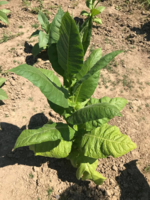
Good to know! Thank you! And now for something completely different: My burley is making me feel like I don't have a clue what I'm doing. Whether that is true or not is maybe beside the point. It seems to be maturing rapidly before it has flowered. At first I thought maybe it needed water as it has been very hot (90 degree days and no rain for a while now) so I watered it but it does look more like leaf maturation. I remember reading that burley yellows before other varieties. I don't know what variety it is. It was sold to me as "burley" seedlings from a local farm market. It seems to be a good ways off from flowering and my other two varieteies already have flowers that are dying. Any suggestions?The trichomes on the upper surface of tobacco leaf secrete alkaloids. (That's what kills those wayward gnats.) It is water soluble, and rinses away every time it rains. But with leaf that is still alive and attached to a living plant that is still attached to its roots (the plant's nicotine factory), the leaf's trichomes promptly replenish their anti-herbivore coating of alkaloids.
If you rinse primed leaf, or even leaf on a stalk-cut plant, there is no longer a source for nicotine replenishment. How much of an impact does that make on the quality of the cured leaf? Probably not a lot, but definitely not zero impact.
Bob

Photos would help.Good to know! Thank you! And now for something completely different: My burley is making me feel like I don't have a clue what I'm doing. Whether that is true or not is maybe beside the point. It seems to be maturing rapidly before it has flowered. At first I thought maybe it needed water as it has been very hot (90 degree days and no rain for a while now) so I watered it but it does look more like leaf maturation. I remember reading that burley yellows before other varieties. I don't know what variety it is. It was sold to me as "burley" seedlings from a local farm market. It seems to be a good ways off from flowering and my other two varieteies already have flowers that are dying. Any suggestions?
Photos would help.

Phew! I'm pleased that's all it is. That means most of it will fall off as you handle them.Just dirt, insect poop, etc... A lot of it was covered with corn tassles too. It had not yet been cleaned at all when picture was taken.

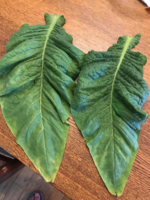
no, I put them there for the picture. The lighting was better there. I will admit I have thought about that though because I read on this site that someone cured their leaves by laying them in the lawn and it worked well. Is the black/dark green a bad sign?You're air-curing them on the grass?
Bob
Needed context: what variety, at what stage was it primed, what stalk level, how was is being air-cured (conditions), for how long has it been air curing?Is the black/dark green a bad sign?
yikes. This picture is upper/midstalk bright leaf. It appeared ripe when primed, the plant was topped at least two weeks ago (I can't remember exactly when...oops). I am yellowing/wilting it in the shade with the intention of sun curing it. It is hanging from a tree branch by wire I ran through the stem. It is in all day shade. Hot, dry days (upper 80's, lower mid 90's) unseasonably cold nights (upper 50's lower 60's). It is usually soaked with dew in the morning but has only been "curing" for a few days now. I have seen this kind of blackening before on greenish leaf put in the sun. These are kind of experimental leaves I primed to try and figure out how things would cure in this weather. (I may have a picture of them right after priming)Needed context: what variety, at what stage was it primed, what stalk level, how was is being air-cured (conditions), for how long has it been air curing?
My immediate thought is that it looks like blue mold.
Bob
 www.invasive.org
 burleytobaccoextension.ca.uky.edu

We discuss any variety of tobacco, as well as numerous approaches to growing, harvesting, curing, and finishing your crop. Our members will attempt to provide experience-based answers to your questions.