Now, that the harvest is in, cured and stabilized, I have moved on to fermentation of several of my varieties. This totally new for me and I was a little nervous. What if I ruin all my hard work? What if it just becomes a rotten mess? Remember, I have never tried this before and have only the information I glean from books, internet and forums like this to learn from. Luckily, I am inventive person and when I put my mind to something, can be quite persistent. I have also been incredibly lucky (that helps). I have two main ways I ferment my tobacco and I am happy to share what I have learned through trial and error with the group. It is also fun and educational for me to delve a little bit deeper into the chemistry of tobacco fermentation and what you can expect under different circumstances from different varieties.
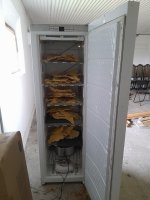
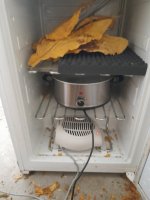
My first invention works fair enough, although many easy improvements could be made. I have taken an old freezer from the dump., cleaned it and removed the motor, etc. It can be used either as a kiln or fermenting cabinet, depending on the technique used. For fermentation, I simply put a slow cooker on the lowest shelf on low. This will consistently heat the tobacco to about 45-48 degrees C and keeps it very moist inside. This setup is best for smaller leaves and shorter fermentation cycles. There is a vent hole at the top which can be opened or closed to allow heat and moisture to escape. Control of environmental factors is limited with this setup, but it was practically free to build and uses very little energy. Mold risk is an issue due to high moisture. Moisture can be reduced by opening the vent hole at the top but the temperature will also fall to about 40-43 degrees C. I also manually air out 2-3 times a day by simply opening the door. The top shelf is warmer and more humid than the bottom shelves, so I rotate the tobacco from shelf to shelf as necessary. If it gets too dry, I simply move it to a higher shelf and the opposite if think it is getting too moist.
My first attempts were with Havana and Virginia Gold flue cured. Both varieties began to show signs of mold after about two weeks, so I stopped the fermentation. Serendipidously, this turned out to be fine for these two varieties and the uses I have for them. The virginia is perfectly fermented and very sweet. It will be amazing for just about any use, but I plan on using it mostly for cigarette blends and some pipe blends. The stems make a mild, sweet snuff. I was scared that I ruined the Havana, since I have read Havana takes many weeks to ferment, but what I have learned is that fermentation times vary greatly depending on what you plan on using the tobacco for. Shorter and longer fermentation times both have their advantages. Since I plan to use these smaller Havana leaves mostly for cheeroot wrappers, a short fermentation time is just fine, especially after a lengthy aging process. I have rolled a couple newly fermented leaves into cheeroots just to test them and they were shockingly good. (perhaps a little new, harsh, spicy) It tastes just a cigar should with plenty of oils and flavor which should only improve with age. The delicate volatile oils were not broken down through aggressive, longer fermentation. I have also fermented small leaved fire cured Kentucky with this setup for three weeks resulting in some of the most amazingly smelling stuff. Words do no justice. I am very excited to work with it after aging.
My second invention is genious, but was not immediately successful. The first prototype and method were disasters 100%. I lost an entire crop of air cured virginia, nearly burned the house down, lost my investment in equipment and had to start from scratch. This happens sometimes during development and is the high price one pays for being inventive. Not every idea is a success. At this point, I would just like to say briefly, don't be an idiot like me. ALWAYS conduct these risky and somewhat dangerous experiments with potentially flammable things outdoors and away from wooden structures. Use thermostats if possible. I could give a description of my failed device, but it is not necessary.
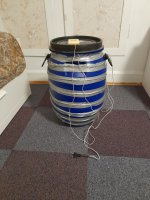
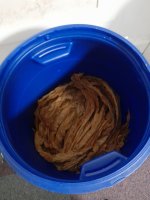
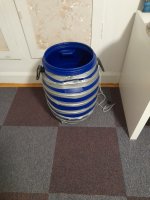
After I mourned the loss of my air cured Virginia (luckily I had a bunch of flue cured left), I took myself together, accepted the loss and tried again. This time, I moved the entire setup outside to a concrete structure with concrete walls and floor where nothing could burn. Essentially, my invention is a 60L HDPE barrel with a 12m long aquarium heater cable evenly wrapped around the outside of the barrel from top to bottom and duct taped in place. Around this, a 5 mm thick foam sleeping bag pad is wrapped around the entire thing and again fastened with duct tape. There is an noninsulated gap at the top near the lid. When tobacco is cased to about 20% and packed LOOSELY in the barrel (not forcefully packed tight) it will heat up nice and evenly to almost exactly 47 deg. C. I monitor heat inside the barrel with a cheap inside/outside weather thermometer. The probe is inside the barrel and the digital screen outside the barrel. The thermometer and monitoring is necessary as fermentation will cause the temperature to rise and fall as it progresses. I rotate and mist the tobacco inside the barrel two to three times a day. Sometimes the leaves touching the sides of the barrel can get dry, so daily, manual rotation is necessary. This also avoids hot/cold spots. The bottom can be colder, so I set the barrels on 2 cm thick pieces of styrafoam to insulate the bottoms. I also set a round piece of wood in the bottom of the barrels on the inside so the tobacco does not touch the plastic bottom, which can collect excess moisture and lead to mold/rot. I later learned that if I placed a 3,5 cm thick yard furniture pillow on top of the barrels, this prevents heat loss from the uninsulated top and can increase the temperature inside to almost precisely 51 degrees C. This temperature plus frequent airation and stirring will result in an extremely fast and aggressive fermentation. This is great for some thick leaved varieties, fuller fermentation and complete breakdown of starches and sugars. NOTE: This may not always be your goal, depending on what you want to achieve, but is a great way to regulate the temperature in this setup. In this way you can shift from a 45-47 degree fermentation to a 47-51 degree fermentation without any difficulty or effort. This gives the fermentation barrels a dual mode of fermentation. Faster/hotter and cooler/slower. If you discover you can not reach 51 degrees, simply place more yard furniture pillows on top until the desired temperature is reached. If the fermentation runs away from you and it gets too hot, move the entire setup to a cold unheated room with no top insulating pillows. I have three 60L barrels capable of fermenting up to 180 L of tobacco at a time. Success!
My first trials with this setup were with Burley and Golden Burley. I ran it 45-47 degrees C for about two weeks and began to see some signs of mold in the leaves, so I stopped the fermentation. I misted too heavily and the moisture was too high. Again, I was sad because I had read the need for many, many weeks of fermentation for these varieties. I stabilized it and sadly began to vacuum pack for aging, when I noticed something. This tobacco was simply amazing! The Burley was deliciously cocoa scented and the Golden Burley a delicious earthy, nutty cream. Why? More on this later. What I discovered by accident, was that shorter fermentation times of Burley varieties do not have time to break down the volatile oils, pyrazines, etc. that result in these delicious flavors/scents. After casing and aging, this tobacco will be prime pipe tobacco and cigarette tobacco.
The next runs were with Havana, Burley and Golden Burley, but this time with less moisture, more frequent stirring and 3 weeks at 47 deg. C followed by two weeks at 51 deg. C and two days at 45 deg. C. These tobaccos were fully fermented. The Havana was dark and very smooth. It will make a fantastic filler/binder. I cased it very lightly with dark rum. After aging, I can only imagine how delicious this will be. The Burley and Golden Burley was a different story. They were both fully fermented, but they began to emanate an extremely stong ammonia smell from the barrels when opened. This began to lessen towards the end. When I stopped the fermentation and spread it out to dry/stabilize, it still had an unpleasant cat piss odor. Again, I overreacted and was devastated. My burleys! Destroyed! Why, God, why? Etc. This was not the case, luckily and after a few days the Burley was ammonia free. The Golden Burley has taken a week to outgas, but is also fine. With casing and aging, volatile pyrazines and other pleasant scent/flavor causing things will occur within the tobacco due to Maillard reactions. It will also be amazing, but different due to the different, fuller fermentation. It will be more dark, full, smooth, earthy and rich with fewer topnotes, but more depth, resulting in pipe tobacco extraordinaire.
I am currently fermenting air cured kentucky, which apparently requires 3-4 weeks at 47 deg. C followed by 2-3weeks at 51 deg. C due to the thick leaves. It also releases a fair amount of ammonia. I am also fermenting Badischer Gudertheimer (an old German variety suited to the Dansih climate) which needs slightly cooler/shorter fermentation to preserve the volatiles which give it its delicately, cigarlike flavor. I can summarize what I have learned.
1. Different tobaccos and different intended usage require different fermentation times and temperatures.
2. Some varieties have larger of amounts of nitrogen trapped within their leaves resulting in large releases of ammonia gas. Burley is an example. They can be outgassed completely at the end of fermentation. Ammonia dissipates easily.
3. Shorter, cooler fermentation results in preservation of more volatile oils that give the tobacco its smell and flavor. It is not wrong to ferment for shorter periods.
4. Longer fermentation results in complete breakdown of volatiles, starches and will begin to break down nitrite-nitrate-ammonia, resulting in smoother, richer tobacco with a wonderful, but different flavor profile. Aging results in Maillard reactions which will bring back much of these volatiles over time.
Thanks for letting me post here. Please come with comments, criticism, corrections or input.
Love from Danish countryside
My first invention works fair enough, although many easy improvements could be made. I have taken an old freezer from the dump., cleaned it and removed the motor, etc. It can be used either as a kiln or fermenting cabinet, depending on the technique used. For fermentation, I simply put a slow cooker on the lowest shelf on low. This will consistently heat the tobacco to about 45-48 degrees C and keeps it very moist inside. This setup is best for smaller leaves and shorter fermentation cycles. There is a vent hole at the top which can be opened or closed to allow heat and moisture to escape. Control of environmental factors is limited with this setup, but it was practically free to build and uses very little energy. Mold risk is an issue due to high moisture. Moisture can be reduced by opening the vent hole at the top but the temperature will also fall to about 40-43 degrees C. I also manually air out 2-3 times a day by simply opening the door. The top shelf is warmer and more humid than the bottom shelves, so I rotate the tobacco from shelf to shelf as necessary. If it gets too dry, I simply move it to a higher shelf and the opposite if think it is getting too moist.
My first attempts were with Havana and Virginia Gold flue cured. Both varieties began to show signs of mold after about two weeks, so I stopped the fermentation. Serendipidously, this turned out to be fine for these two varieties and the uses I have for them. The virginia is perfectly fermented and very sweet. It will be amazing for just about any use, but I plan on using it mostly for cigarette blends and some pipe blends. The stems make a mild, sweet snuff. I was scared that I ruined the Havana, since I have read Havana takes many weeks to ferment, but what I have learned is that fermentation times vary greatly depending on what you plan on using the tobacco for. Shorter and longer fermentation times both have their advantages. Since I plan to use these smaller Havana leaves mostly for cheeroot wrappers, a short fermentation time is just fine, especially after a lengthy aging process. I have rolled a couple newly fermented leaves into cheeroots just to test them and they were shockingly good. (perhaps a little new, harsh, spicy) It tastes just a cigar should with plenty of oils and flavor which should only improve with age. The delicate volatile oils were not broken down through aggressive, longer fermentation. I have also fermented small leaved fire cured Kentucky with this setup for three weeks resulting in some of the most amazingly smelling stuff. Words do no justice. I am very excited to work with it after aging.
My second invention is genious, but was not immediately successful. The first prototype and method were disasters 100%. I lost an entire crop of air cured virginia, nearly burned the house down, lost my investment in equipment and had to start from scratch. This happens sometimes during development and is the high price one pays for being inventive. Not every idea is a success. At this point, I would just like to say briefly, don't be an idiot like me. ALWAYS conduct these risky and somewhat dangerous experiments with potentially flammable things outdoors and away from wooden structures. Use thermostats if possible. I could give a description of my failed device, but it is not necessary.
After I mourned the loss of my air cured Virginia (luckily I had a bunch of flue cured left), I took myself together, accepted the loss and tried again. This time, I moved the entire setup outside to a concrete structure with concrete walls and floor where nothing could burn. Essentially, my invention is a 60L HDPE barrel with a 12m long aquarium heater cable evenly wrapped around the outside of the barrel from top to bottom and duct taped in place. Around this, a 5 mm thick foam sleeping bag pad is wrapped around the entire thing and again fastened with duct tape. There is an noninsulated gap at the top near the lid. When tobacco is cased to about 20% and packed LOOSELY in the barrel (not forcefully packed tight) it will heat up nice and evenly to almost exactly 47 deg. C. I monitor heat inside the barrel with a cheap inside/outside weather thermometer. The probe is inside the barrel and the digital screen outside the barrel. The thermometer and monitoring is necessary as fermentation will cause the temperature to rise and fall as it progresses. I rotate and mist the tobacco inside the barrel two to three times a day. Sometimes the leaves touching the sides of the barrel can get dry, so daily, manual rotation is necessary. This also avoids hot/cold spots. The bottom can be colder, so I set the barrels on 2 cm thick pieces of styrafoam to insulate the bottoms. I also set a round piece of wood in the bottom of the barrels on the inside so the tobacco does not touch the plastic bottom, which can collect excess moisture and lead to mold/rot. I later learned that if I placed a 3,5 cm thick yard furniture pillow on top of the barrels, this prevents heat loss from the uninsulated top and can increase the temperature inside to almost precisely 51 degrees C. This temperature plus frequent airation and stirring will result in an extremely fast and aggressive fermentation. This is great for some thick leaved varieties, fuller fermentation and complete breakdown of starches and sugars. NOTE: This may not always be your goal, depending on what you want to achieve, but is a great way to regulate the temperature in this setup. In this way you can shift from a 45-47 degree fermentation to a 47-51 degree fermentation without any difficulty or effort. This gives the fermentation barrels a dual mode of fermentation. Faster/hotter and cooler/slower. If you discover you can not reach 51 degrees, simply place more yard furniture pillows on top until the desired temperature is reached. If the fermentation runs away from you and it gets too hot, move the entire setup to a cold unheated room with no top insulating pillows. I have three 60L barrels capable of fermenting up to 180 L of tobacco at a time. Success!
My first trials with this setup were with Burley and Golden Burley. I ran it 45-47 degrees C for about two weeks and began to see some signs of mold in the leaves, so I stopped the fermentation. I misted too heavily and the moisture was too high. Again, I was sad because I had read the need for many, many weeks of fermentation for these varieties. I stabilized it and sadly began to vacuum pack for aging, when I noticed something. This tobacco was simply amazing! The Burley was deliciously cocoa scented and the Golden Burley a delicious earthy, nutty cream. Why? More on this later. What I discovered by accident, was that shorter fermentation times of Burley varieties do not have time to break down the volatile oils, pyrazines, etc. that result in these delicious flavors/scents. After casing and aging, this tobacco will be prime pipe tobacco and cigarette tobacco.
The next runs were with Havana, Burley and Golden Burley, but this time with less moisture, more frequent stirring and 3 weeks at 47 deg. C followed by two weeks at 51 deg. C and two days at 45 deg. C. These tobaccos were fully fermented. The Havana was dark and very smooth. It will make a fantastic filler/binder. I cased it very lightly with dark rum. After aging, I can only imagine how delicious this will be. The Burley and Golden Burley was a different story. They were both fully fermented, but they began to emanate an extremely stong ammonia smell from the barrels when opened. This began to lessen towards the end. When I stopped the fermentation and spread it out to dry/stabilize, it still had an unpleasant cat piss odor. Again, I overreacted and was devastated. My burleys! Destroyed! Why, God, why? Etc. This was not the case, luckily and after a few days the Burley was ammonia free. The Golden Burley has taken a week to outgas, but is also fine. With casing and aging, volatile pyrazines and other pleasant scent/flavor causing things will occur within the tobacco due to Maillard reactions. It will also be amazing, but different due to the different, fuller fermentation. It will be more dark, full, smooth, earthy and rich with fewer topnotes, but more depth, resulting in pipe tobacco extraordinaire.
I am currently fermenting air cured kentucky, which apparently requires 3-4 weeks at 47 deg. C followed by 2-3weeks at 51 deg. C due to the thick leaves. It also releases a fair amount of ammonia. I am also fermenting Badischer Gudertheimer (an old German variety suited to the Dansih climate) which needs slightly cooler/shorter fermentation to preserve the volatiles which give it its delicately, cigarlike flavor. I can summarize what I have learned.
1. Different tobaccos and different intended usage require different fermentation times and temperatures.
2. Some varieties have larger of amounts of nitrogen trapped within their leaves resulting in large releases of ammonia gas. Burley is an example. They can be outgassed completely at the end of fermentation. Ammonia dissipates easily.
3. Shorter, cooler fermentation results in preservation of more volatile oils that give the tobacco its smell and flavor. It is not wrong to ferment for shorter periods.
4. Longer fermentation results in complete breakdown of volatiles, starches and will begin to break down nitrite-nitrate-ammonia, resulting in smoother, richer tobacco with a wonderful, but different flavor profile. Aging results in Maillard reactions which will bring back much of these volatiles over time.
Thanks for letting me post here. Please come with comments, criticism, corrections or input.
Love from Danish countryside