

Making a Simple Pipe Shank Tool
The handy rod-like element in a Czech pipe tool is often way too short for many of the longer pipe shanks, like those on Canadians.
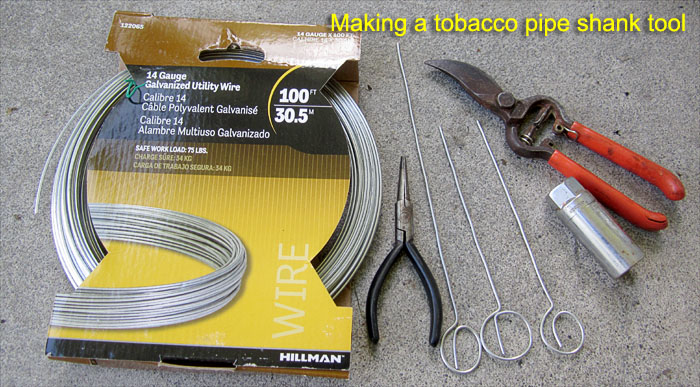
I needed to replace the trellis wires on my grape trellis, as well as my brambles. I purchased this 14 gauge, galvanized steel wire at the local hardware store. (100 feet of this wire is cheaper than all but the least expensive commercial pipe tools.) Having used aluminum wire for stringing tobacco, I was impressed with how stiff this steel wire felt.
Since I needed only about 60 feet of the wire for my trellis refurbish, I had extra wire to play with. I decided to make a pipe shank tool. While 12 gauge steel wire would probably be a better thickness for a pipe tool (a better match to the average diameter of the smoke hole in most briar pipes), I doubt that I could successfully cut and bend it using my primitive tools. If you have access to a metal or machine shop, then use the 12 gauge, otherwise go with the 14 gauge.
I used the spark plug socket for creating the circular bend, and the small needle-nose pliers for the angled bends. It required quite a bit of effort to create the bends, so crud within a pipe shank is no match.
A shank tool should not have a sharp edge at the business end, so if one is created with the cutting process, it will need to be filed off. A 90° cut is ideal. An anvil and a hammer will remove any wiggles in the shaft. I didn't bother with them.
The wire in the center of the circle provides some purchase for my fingers. You can sculpt a panda or a star ship, but it does need a shape that is convenient to hold. The length of the shaft should be only as long as the longest shank on any of your pipes. The long one shown here will make it through my longest bamboo shank on the corncob sitters that I make.
Bob
The handy rod-like element in a Czech pipe tool is often way too short for many of the longer pipe shanks, like those on Canadians.
I needed to replace the trellis wires on my grape trellis, as well as my brambles. I purchased this 14 gauge, galvanized steel wire at the local hardware store. (100 feet of this wire is cheaper than all but the least expensive commercial pipe tools.) Having used aluminum wire for stringing tobacco, I was impressed with how stiff this steel wire felt.
Since I needed only about 60 feet of the wire for my trellis refurbish, I had extra wire to play with. I decided to make a pipe shank tool. While 12 gauge steel wire would probably be a better thickness for a pipe tool (a better match to the average diameter of the smoke hole in most briar pipes), I doubt that I could successfully cut and bend it using my primitive tools. If you have access to a metal or machine shop, then use the 12 gauge, otherwise go with the 14 gauge.
I used the spark plug socket for creating the circular bend, and the small needle-nose pliers for the angled bends. It required quite a bit of effort to create the bends, so crud within a pipe shank is no match.
A shank tool should not have a sharp edge at the business end, so if one is created with the cutting process, it will need to be filed off. A 90° cut is ideal. An anvil and a hammer will remove any wiggles in the shaft. I didn't bother with them.
The wire in the center of the circle provides some purchase for my fingers. You can sculpt a panda or a star ship, but it does need a shape that is convenient to hold. The length of the shaft should be only as long as the longest shank on any of your pipes. The long one shown here will make it through my longest bamboo shank on the corncob sitters that I make.
Bob


