A different color flower

Status
Not open for further replies.

jekylnz

Well-Known Member
Joined
Jan 19, 2013
Messages
1,357
Points
48
Location
Auckland, New Zealand, New Zealand
Thats a bright one....I had some havana that was bright pink last year(not quite that bright though)
I have a aztec rustica variety thats probably the same
I like your avatar;)
 

JessicaNicot

Well-Known Member
Joined
Apr 29, 2013
Messages
417
Points
0
Location
Raleigh, NC
I wish I would have seen that before. Interesting that two Peruvian varieties have red flowers.

there are much darker ones from Peru near machu picchu. in fact the original seed lots segregated for "red" and white flowers. its just a guess, but I believe that those particular seed lots (TI 722R & W; TI 732R & W) from such a remote region are likely representative of the most "primitive" (pre-cultivation) tobacco you'll find. the theoretical origins of N. tabacum (a natural hybridization event between two other Nicotiana species) was believed to have been the highlands of peru-bolivia-(maybe argentina), but I think our collection only has one accession from Bolivia and none from the border region of argentina.
 

deluxestogie

Administrator
Staff member
Joined
May 25, 2011
Messages
26,629
Points
113
Location
near Blacksburg, VA
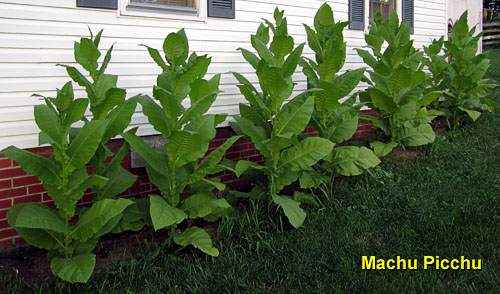
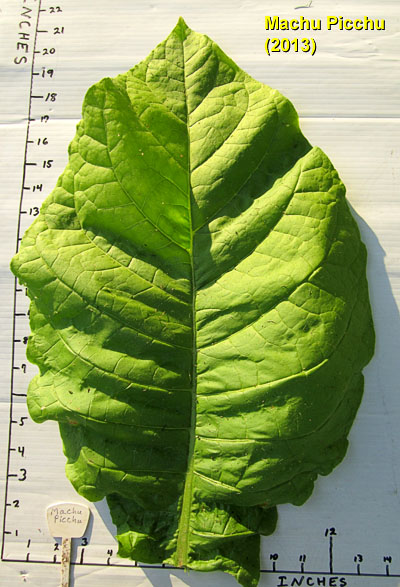
For the past two seasons, I have grown PI 116159 (TI 719), which is the 1936 accession from Peru (Machu Picchu) labeled as "White-flowered." I have taken the bold liberty of simply naming it Machu Picchu. It was collected at ~6900 feet elevation. At my elevation in Virginia (~1900 feet), it produces consistently pink blossoms. The leaf is classed as "Cigar Wrapper," and does appear to be a large-leaf wrapper type.

Of course, there is no way of telling if it was native to the area, or a later import. Machu Picchu was curiously never discovered by the Spanish, even though it was constructed by Pachacuti a generation prior to the Spanish Conquest. The first knowledge of Machu Picchu by "Westerners" was its discovery in 1911 by Hiram Bingham (supported as the National Geographic Society's very first expedition!). At the time of the tobacco seed acquisition by USDA's Raymond Stadelman in 1936, the same two families encountered by Hiram Bingham still were the only inhabitants of Huayna Picchu--the neighboring peak--and the growers of that tobacco from which Stadelman collected the seed.

If it is a primitive--has undergone little agricultural improvement--then it represents a truly parental place in the origin of cigar wrapper.

My Machu Picchu leaf produces an aromatic wrapper with a uniquely mild, almost sweet, flavorful taste. Its stretch is not as good as commercial wrapper, and in the lower leaves tends to produce a somewhat mottled coloration. The upper leaf kilns to a dark chocolate brown. The nicotine (though reported in the GRIN observations as a whopping 40mg/g) is fairly mild. Its burn qualities are on the low side, though adequate.

Garden20130722_822_MachuPicchu_bedOblique_500.jpg


Garden20130725_838_MachuPicchu_leafSize_400.jpg


Bob
 

NRustica

Well-Known Member
Joined
Apr 7, 2012
Messages
259
Points
0
Location
Beautiful Lake of the Ozarks
there are much darker ones from Peru near machu picchu. in fact the original seed lots segregated for "red" and white flowers. its just a guess, but I believe that those particular seed lots (TI 722R & W; TI 732R & W) from such a remote region are likely representative of the most "primitive" (pre-cultivation) tobacco you'll find. the theoretical origins of N. tabacum (a natural hybridization event between two other Nicotiana species) was believed to have been the highlands of peru-bolivia-(maybe argentina), but I think our collection only has one accession from Bolivia and none from the border region of argentina.

That's very interesting.
 

JessicaNicot

Well-Known Member
Joined
Apr 29, 2013
Messages
417
Points
0
Location
Raleigh, NC
For the past two seasons, I have grown PI 116159 (TI 719), which is the 1936 accession from Peru (Machu Picchu) labeled as "White-flowered." I have taken the bold liberty of simply naming it Machu Picchu. It was collected at ~6900 feet elevation. At my elevation in Virginia (~1900 feet), it produces consistently pink blossoms. The leaf is classed as "Cigar Wrapper," and does appear to be a large-leaf wrapper type.

Of course, there is no way of telling if it was native to the area, or a later import. Machu Picchu was curiously never discovered by the Spanish, even though it was constructed by Pachacuti a generation prior to the Spanish Conquest. The first knowledge of Machu Picchu by "Westerners" was its discovery in 1911 by Hiram Bingham (supported as the National Geographic Society's very first expedition!). At the time of the tobacco seed acquisition by USDA's Raymond Stadelman in 1936, the same two families encountered by Hiram Bingham still were the only inhabitants of Huayna Picchu--the neighboring peak--and the growers of that tobacco from which Stadelman collected the seed.

If it is a primitive--has undergone little agricultural improvement--then it represents a truly parental place in the origin of cigar wrapper.

Bob

per Stadelman's original letter (dated 5-14-1936), he notes "whitish flowers", which I suppose is consistent with the very light pink I see in my photos for this accession also. how did you know about the family on the other peak being the same one that Stadelman received the seed from? I have two names of people from that region who he received seed from but as far as I know, that information isn't published anywhere.
 

deluxestogie

Administrator
Staff member
Joined
May 25, 2011
Messages
26,629
Points
113
Location
near Blacksburg, VA
...how did you know about the family on the other peak?
I was afraid someone would ask that. Several years ago, I did some extensive reading about the conquest of the Inca, the discovery of Machu Picchu 1911, and the subsequent history of that site (entangled in the more recent searches for the lost Inca capital of Vilca Bamba, which was what Bingham originally thought he had discovered). National Geographic sent a second expedition there (as I recall, about a year before Stadelman's seed accession), and commented on the interesting fact that the families of the sons of the two farmers encountered by Bingham were still the only inhabitants of the nearly inaccessible Huayna Picchu.

Unfortunately, though I still have all my reference material, it's fairly extensive, and would require hours to track down the citations. I'm getting lazy in my old age, but I'll have a look.

Bob
 

chillardbee

Well-Known Member
Joined
May 29, 2013
Messages
888
Points
63
Location
Chilliwack BC, Canada (south western Canada)
I'll just throw this out there becuase I've seen colour changes in the plants before. This year we had flowers that were almost white, pale pink, to regular pink at the start of the bloom and through the season, got darker in colour and in some cases, almost red. I am thinking that the cause of this might be changes in moisture, temprature and maybe the amount of sunlight. I've seen this on fireweed too where the blooms can be a light pink (poor nectar production) to dark purplish pink (excellent nectar production). The weather we have leading up to the bloom seems to effect it. But nutrients can too. Just as you can see the effects on growth and leaf colour, why not bloom colour?
 
Status
Not open for further replies.
Top