

With the lapse of time people and their tastes change. How was the tobacco/cigarette habit in 19[SUP]th[/SUP] and early 20[SUP]th[/SUP] century ? What were the people smoking those times ? Let's take a look. I hope you enjoy the article.
A piece of Orient on bank of the Elbe
Germany had became an immigration country especially since the end of 19th century. According to June 1907 statistics the number of foreign workers in the Germany was approximately one million. Among those workers which are mostly Eastern and Southeastern European there were Ottoman citizens.
Although Germany is not famous for its hospitality to immigrants, those years Ottoman citizen were popular, respectable and welcome guests. The newspapers were writing that they were beautifying the streets with the fezes on their heads.
The factory buildings where Turkish workers used to work were also inspired by Ottoman (and Oriental) architecture. Those immigrants were especially working in cigarette factories. At that time the cigarette companies were not only naming their brands evoking Ottoman Empire - Orient - (like the brands; Yenidje, Salem Aleikum, Orient, Calife de Bagdad, Ottoman etc.) but also importing the tobacco and labour force from the Ottoman Empire.
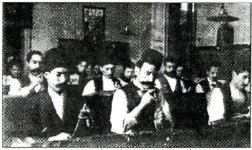
Ottoman workers in a German tobacco factory.
After the railroad passing through the Balkans was completed, Dresden became the center of tobacco industry in Germany. Dresden is now the capital of the State of Saxony which is founded on the banks of Elbe River. Because of the art object it reserves the city is also called as "Florence of the Elbe". With the railroad, tobaccos grown in the Ottoman Empire was easily transported to Dresden. From 1890 to WWII, 60% of the tobacco products were produced in 41 factories located in Dresden.
A piece of Orient on bank of the Elbe
In 1886, one of the former biggest tobacco company owner was Hugo Zietz. He was a merchant who imports tobacco from the Ottoman Emprie and manufacturing Turkish blend cigarettes in his factories.
As the business grows the factories became overloaded and he decided to build a new Oriental style building which is suitable to his products. Those years Zietz was using the tobaccos which were grown in Yenidje region for manufacturing the "Salem Aleikum" brand. So the name of the factory was clear "Orientalische Tabak und Zigarettenfabrik Yenidze" (Yenidje Oriental Tobacco and Cigarette Factory).
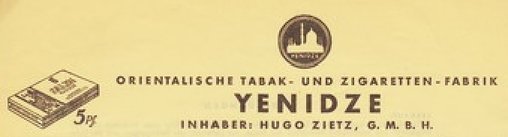
The headline of a invoice belongs to "Yenidze".
He hires an architect, Prof. Martin Hammitzsch, to build a new factory for him near to the Dresden train station. That factory would manufacture the "Salem Aleikum" cigarettes and also be a advertisement instrument for the company.
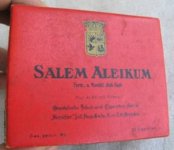
A pack of "Salem Aleikum".
Hammitzsch takes the funerary complex of Sultan Qaitbay (Mamluk Sultan of Egypt) as a model which was completed in 1474 in Cairo, Eygpt.
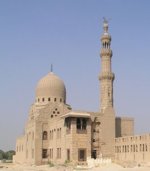
Qaitbay Mosque in Cairo, Egypt.
Zietz finds Hammitzsch's design really appealing which has a 50 meters in diameter luminous stained glass dome and a 62 meters long minaret shaped factory chimney, - briefly a mosque shaped design - and the construction starts in 1907. "Salem Aleikum" was written on the factory with ligted-up big letters. In Dresden where Baroque architecture was dominant, this design was found strange by officals and folks but in spite of all obstructions it's completed in 1909.
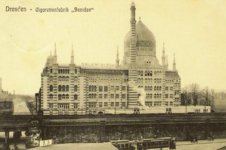
A postcard from 1909.
Those days building factory chimneys was banned so Hammitzsch seems like a smart architect by hiding the factory chimney in a minaret. He also achieved the "exotic" design to reflect the atmosphere where tobacco was grown, the Orient. The people of Dresden also named this factory as "Tabakmoschee" (Tobacco Mosque).
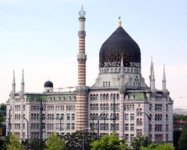
"Yenidze" today.
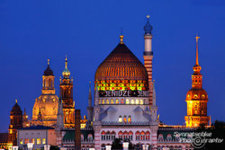
Night view of "Yenidze", when the lights are on.
Since the building was put into operation, 11 January 1909, "Yenidze" became a landmark of the city. For some, the sparkling dome became a sign of industrialisation of the city and for some it was a source of inspiration to write a poem. A writer of Sachsen Post newspaper took a title for his article on 23 February 1910; "A piece of Orient on bank of the Elbe".
Zietz achieved his aim by building a monumet like fancy advertising instrument but this building didn't bring good luck to Hammitzsch. The State Chamber of Architectures which was ultra conservative - because of building's resemblance to a mosque - decided to strike off the register of him. He moved to Chemnitz where he was awarded the title of professor in 1918. He moved back to Dresden in 1920 as an academic and joined to the German National People's Party in 1922. Then he joined NSDAP (Nazi Party) in 1935 and married the half-sister of Hitler. Until the end of the WWII he worked for the government. After the war he commited suicide and his body was found in a forest district.
While Yenidze factory was in construction Zietz requested tobacco experts from Ottoman Government so 7 tobacco experts were sent to Germany from "Régie Company" (Ottoman tobacco monopoly). Meanwhile 470 Turkish people from Filibe (modern day Plovdiv, Bulgaria) were sent to the "Yenidze factory" to receieve training, so this factory became the first place where Turkish workers were employed in Germany. With the Turkish experts and workers; brands "Salem Aleikum", "Salem Gold", "Salem No.6" and "Muhammed" brand cigarettes were manufactured. But Zietz sells the company to Reemtsma in 1924.

"Salem Aleikum" and "Salem Gold" advertisement.
During the "Bombing of Dresden" in WWII which was one of the great destructions in the history, while the city was razed to the ground by US and British air forces the dome of the Yenidze factory fell down and suffered a significant damage. After the war when the city was belong to East Germany the building was repaired and used as a head office of tobacco monopoly and a tobacco warehouse. After unification of Germany, in 1996 the building was restored extensively (it costed 38 million Euros - those times it was "Deutsche Marks") and it's still in use as a commercial and a cultural building, it also has a restaurant on the "dome",terrace.

Terrace restaurant of "Yenidze".
Enver Bey Zigaretten
Enver Paşa who was one of the significant leaders of Young Turk Revolution (Second Constituonal Era, between 1881-1922) was tasked as a military attaché between 1909-1912 in Berlin. He was one of the figures who created the Ottoman-German Alliance during WWI so he was a favorite political figure and an ally for Germans. There were postcards and stamps printed with his photos in Germany and also his name was given to a brigde crossing Teltowkanal, "Enver Pascha Brücke" (Enver Paşa Bridge). Those years "Enverland" was written on the trains which were travelling from Berlin to İstanbul. While "Enverland" written railway cars were carrying passangers from Berlin to İstanbul, buses were touring in the streets of Berlin with advertisement posters of Enver Bey cigarettes.
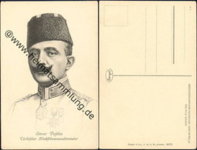 -
-
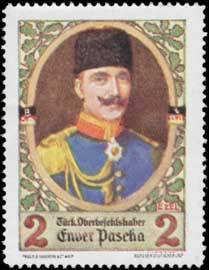
A German postcard and a stamp with Enver Paşa's photo.
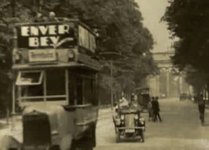
A bus with the "Enver Bey" advertisement in Berlin (Brandenburg Gate is in the background).
The German Emperor Wilhelm II who established the government owned "Enver Bey Zigarettenfabrik" (Enver Bey cigarette factory) in 1926, reaped a great success by advertising the brand succesfully. Under those conditions Enver Bey Zigaretten became the best-seller cigarette in Germany.
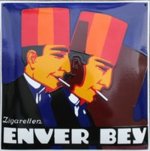
Enver Bey cigarette pack.
In early 20th century there were approximately 200 cigarette factories in Germany and most of them was manufacturing Turkish blends which are made of Oriental tobaccos. Cigarette names were also "Oriental" like Elmas, Sultan, Sanussi, Ova, Minaret, Sefer Pascha etc.
Domination of Turkish cigarettes which are manufactured with Oriental tobaccos had lasted long years in Europe and America. Turkish tobaccos and cigarettes had oppressed the native land of tobacco. Turkish cigarette brands (like Murad, Fatima, Osman*, Turkish Trophy etc.) which were launched by American tobacco companies made Turkish tobaccos very popular in the US.
Starting with late 1920s, American blend cigarettes started to dominate the market in the US and with the WWII they also dominated the European market.
Until the WWII Turkish cigarettes were obviosuly the leader of the market in Europe. But those years of war was the beginning of the fall for Turkish cigarettes. As is seen, the relation between tobacco and politics has never broken up along history.
*There's a quick write up about the brand "Osman" here in the forum.
A piece of Orient on bank of the Elbe
Germany had became an immigration country especially since the end of 19th century. According to June 1907 statistics the number of foreign workers in the Germany was approximately one million. Among those workers which are mostly Eastern and Southeastern European there were Ottoman citizens.
Although Germany is not famous for its hospitality to immigrants, those years Ottoman citizen were popular, respectable and welcome guests. The newspapers were writing that they were beautifying the streets with the fezes on their heads.
The factory buildings where Turkish workers used to work were also inspired by Ottoman (and Oriental) architecture. Those immigrants were especially working in cigarette factories. At that time the cigarette companies were not only naming their brands evoking Ottoman Empire - Orient - (like the brands; Yenidje, Salem Aleikum, Orient, Calife de Bagdad, Ottoman etc.) but also importing the tobacco and labour force from the Ottoman Empire.
Ottoman workers in a German tobacco factory.
After the railroad passing through the Balkans was completed, Dresden became the center of tobacco industry in Germany. Dresden is now the capital of the State of Saxony which is founded on the banks of Elbe River. Because of the art object it reserves the city is also called as "Florence of the Elbe". With the railroad, tobaccos grown in the Ottoman Empire was easily transported to Dresden. From 1890 to WWII, 60% of the tobacco products were produced in 41 factories located in Dresden.
A piece of Orient on bank of the Elbe
In 1886, one of the former biggest tobacco company owner was Hugo Zietz. He was a merchant who imports tobacco from the Ottoman Emprie and manufacturing Turkish blend cigarettes in his factories.
As the business grows the factories became overloaded and he decided to build a new Oriental style building which is suitable to his products. Those years Zietz was using the tobaccos which were grown in Yenidje region for manufacturing the "Salem Aleikum" brand. So the name of the factory was clear "Orientalische Tabak und Zigarettenfabrik Yenidze" (Yenidje Oriental Tobacco and Cigarette Factory).
The headline of a invoice belongs to "Yenidze".
He hires an architect, Prof. Martin Hammitzsch, to build a new factory for him near to the Dresden train station. That factory would manufacture the "Salem Aleikum" cigarettes and also be a advertisement instrument for the company.
A pack of "Salem Aleikum".
Hammitzsch takes the funerary complex of Sultan Qaitbay (Mamluk Sultan of Egypt) as a model which was completed in 1474 in Cairo, Eygpt.
Qaitbay Mosque in Cairo, Egypt.
Zietz finds Hammitzsch's design really appealing which has a 50 meters in diameter luminous stained glass dome and a 62 meters long minaret shaped factory chimney, - briefly a mosque shaped design - and the construction starts in 1907. "Salem Aleikum" was written on the factory with ligted-up big letters. In Dresden where Baroque architecture was dominant, this design was found strange by officals and folks but in spite of all obstructions it's completed in 1909.
A postcard from 1909.
Those days building factory chimneys was banned so Hammitzsch seems like a smart architect by hiding the factory chimney in a minaret. He also achieved the "exotic" design to reflect the atmosphere where tobacco was grown, the Orient. The people of Dresden also named this factory as "Tabakmoschee" (Tobacco Mosque).
"Yenidze" today.
Night view of "Yenidze", when the lights are on.
Since the building was put into operation, 11 January 1909, "Yenidze" became a landmark of the city. For some, the sparkling dome became a sign of industrialisation of the city and for some it was a source of inspiration to write a poem. A writer of Sachsen Post newspaper took a title for his article on 23 February 1910; "A piece of Orient on bank of the Elbe".
Zietz achieved his aim by building a monumet like fancy advertising instrument but this building didn't bring good luck to Hammitzsch. The State Chamber of Architectures which was ultra conservative - because of building's resemblance to a mosque - decided to strike off the register of him. He moved to Chemnitz where he was awarded the title of professor in 1918. He moved back to Dresden in 1920 as an academic and joined to the German National People's Party in 1922. Then he joined NSDAP (Nazi Party) in 1935 and married the half-sister of Hitler. Until the end of the WWII he worked for the government. After the war he commited suicide and his body was found in a forest district.
While Yenidze factory was in construction Zietz requested tobacco experts from Ottoman Government so 7 tobacco experts were sent to Germany from "Régie Company" (Ottoman tobacco monopoly). Meanwhile 470 Turkish people from Filibe (modern day Plovdiv, Bulgaria) were sent to the "Yenidze factory" to receieve training, so this factory became the first place where Turkish workers were employed in Germany. With the Turkish experts and workers; brands "Salem Aleikum", "Salem Gold", "Salem No.6" and "Muhammed" brand cigarettes were manufactured. But Zietz sells the company to Reemtsma in 1924.
"Salem Aleikum" and "Salem Gold" advertisement.
During the "Bombing of Dresden" in WWII which was one of the great destructions in the history, while the city was razed to the ground by US and British air forces the dome of the Yenidze factory fell down and suffered a significant damage. After the war when the city was belong to East Germany the building was repaired and used as a head office of tobacco monopoly and a tobacco warehouse. After unification of Germany, in 1996 the building was restored extensively (it costed 38 million Euros - those times it was "Deutsche Marks") and it's still in use as a commercial and a cultural building, it also has a restaurant on the "dome",terrace.
Terrace restaurant of "Yenidze".
Enver Bey Zigaretten
Enver Paşa who was one of the significant leaders of Young Turk Revolution (Second Constituonal Era, between 1881-1922) was tasked as a military attaché between 1909-1912 in Berlin. He was one of the figures who created the Ottoman-German Alliance during WWI so he was a favorite political figure and an ally for Germans. There were postcards and stamps printed with his photos in Germany and also his name was given to a brigde crossing Teltowkanal, "Enver Pascha Brücke" (Enver Paşa Bridge). Those years "Enverland" was written on the trains which were travelling from Berlin to İstanbul. While "Enverland" written railway cars were carrying passangers from Berlin to İstanbul, buses were touring in the streets of Berlin with advertisement posters of Enver Bey cigarettes.
-
A German postcard and a stamp with Enver Paşa's photo.
A bus with the "Enver Bey" advertisement in Berlin (Brandenburg Gate is in the background).
The German Emperor Wilhelm II who established the government owned "Enver Bey Zigarettenfabrik" (Enver Bey cigarette factory) in 1926, reaped a great success by advertising the brand succesfully. Under those conditions Enver Bey Zigaretten became the best-seller cigarette in Germany.
Enver Bey cigarette pack.
In early 20th century there were approximately 200 cigarette factories in Germany and most of them was manufacturing Turkish blends which are made of Oriental tobaccos. Cigarette names were also "Oriental" like Elmas, Sultan, Sanussi, Ova, Minaret, Sefer Pascha etc.
Domination of Turkish cigarettes which are manufactured with Oriental tobaccos had lasted long years in Europe and America. Turkish tobaccos and cigarettes had oppressed the native land of tobacco. Turkish cigarette brands (like Murad, Fatima, Osman*, Turkish Trophy etc.) which were launched by American tobacco companies made Turkish tobaccos very popular in the US.
Starting with late 1920s, American blend cigarettes started to dominate the market in the US and with the WWII they also dominated the European market.
Until the WWII Turkish cigarettes were obviosuly the leader of the market in Europe. But those years of war was the beginning of the fall for Turkish cigarettes. As is seen, the relation between tobacco and politics has never broken up along history.
*There's a quick write up about the brand "Osman" here in the forum.
Last edited:


