deluxestogie Grow Log 2013

Status
Not open for further replies.

DGBAMA

Well-Known Member
Joined
Feb 10, 2013
Messages
4,418
Points
63
Location
NORTH ALABAMA
look really good Bob. Grown a LOT since the last pics. I guess you are stalk curing the Prilep? Or is it just time to get to work stringing leaves.?

 

deluxestogie

Administrator
Staff member
Joined
May 25, 2011
Messages
26,092
Points
113
Location
near Blacksburg, VA
I guess you are stalk curing the Prilep? Or is it just time to get to work stringing leaves.?
I plan to prime the Prilep and air-cure it. As soon as I get more than 5 continuous minutes of sunshine, I'll begin. Despite the scenic photos from today, it rained most of the time. (I did have time to harvest some veggies that have cried out for attention the past few days.)

I'll be doing the same with the Xanthi and half the Çelikhan. The other half of the Çelikhan will be primed and flue-cured. Unfortunately, I still have some 2012 leaf (mostly thick, top leaf) still color-curing in my shed, beside the hanging garlic.

Bob

NOTE: That clever capital "Ç" is entered with ALT-0199. I'm trying to impress istanbulin. By the way, how is it pronounced?
 

Knucklehead

Moderator
Founding Member
Joined
Oct 18, 2012
Messages
12,777
Points
113
Location
NE Alabama
Has your soil been dry very often this year? Mine has been dry twice since planting in mid - late April. I'm still trying to isolate whether or not that is whole problem with my lack of growth.

How should I remove a plant to look at the roots for nematodes or rot? Pull it or dig it?
 

DonH

Well-Known Member
Joined
Jun 10, 2012
Messages
1,609
Points
0
Location
Massachusetts
Has your soil been dry very often this year? Mine has been dry twice since planting in mid - late April. I'm still trying to isolate whether or not that is whole problem with my lack of growth.

How should I remove a plant to look at the roots for nematodes or rot? Pull it or dig it?
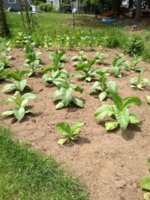
Need some pics in your grow log. It's hard to know what lack of growth means. Your plants looked OK on the 27th of June. I did notice that the grass is crowding your narrow rows. That could easily stunt growth. Grass roots are thick and spread. I would make sure there's at least two feet between the grass and the plants, and even then you will have to keep pulling the grass back.
 

DonH

Well-Known Member
Joined
Jun 10, 2012
Messages
1,609
Points
0
Location
Massachusetts
Need some pics in your grow log. It's hard to know what lack of growth means. Your plants looked OK on the 27th of June. I did notice that the grass is crowding your narrow rows. That could easily stunt growth. Grass roots are thick and spread. I would make sure there's at least two feet between the grass and the plants, and even then you will have to keep pulling the grass back.

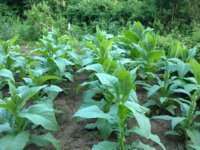
Here's what I mean, Knucks, once the plants get their roots set they really take off. Now with all the rain you may be having root problems, but you did plant the seedlings too early, so it may be taking them longer to get set. Of course the rain doesn't help.

Here are my plants on June 22:

IMG_0419.jpg

Here are the same plants 13 days later:

IMG_0431.jpg

In other words, try not to worry. As long as your plants aren't dead, you will end up with a lot of tobacco, because you planted a lot of plants.
 

Knucklehead

Moderator
Founding Member
Joined
Oct 18, 2012
Messages
12,777
Points
113
Location
NE Alabama
I've been pulling grass lately. It keeps getting ahead of me with all the rain and my preparations for planting the second wave of plants. Even the plants with the landscape fabric are not growing and I've kept those clean around the plants. I haven't posted pictures because the plants are the same size that they were on the 27th. It seemed a little redundant.

BTW. I'm not planning any "cures" or "remedies". I'm not going to start throwing nitrogen at them or anything. All I can do is fight the grass and critters and wait to see what happens. My purpose with all these questions is to learn all I can from this unique situation by eliminating any other variables that may be contributing to the situation besides the weather. (at least in my mind)
 

Knucklehead

Moderator
Founding Member
Joined
Oct 18, 2012
Messages
12,777
Points
113
Location
NE Alabama
I mean identifying any variables besides the weather. Such as root rot or nematodes. Sorry, my edit timed out.
 

DonH

Well-Known Member
Joined
Jun 10, 2012
Messages
1,609
Points
0
Location
Massachusetts
I've been pulling grass lately. It keeps getting ahead of me with all the rain and my preparations for planting the second wave of plants. Even the plants with the landscape fabric are not growing and I've kept those clean around the plants. I haven't posted pictures because the plants are the same size that they were on the 27th. It seemed a little redundant.

BTW. I'm not planning any "cures" or "remedies". I'm not going to start throwing nitrogen at them or anything. All I can do is fight the grass and critters and wait to see what happens. My purpose with all these questions is to learn all I can from this unique situation by eliminating any other variables that may be contributing to the situation besides the weather. (at least in my mind)
Understood. I think it is the weather. But it's good to eliminate the other stuff too. But if it is the weather, once the sun comes out for several days, they will take off.
 

workhorse_01

Well-Known Member
Joined
Apr 10, 2012
Messages
1,959
Points
0
Location
Waycross,Ga.
That's what I'm waiting for. The ground is over saturated.
Understood. I think it is the weather. But it's good to eliminate the other stuff too. But if it is the weather, once the sun comes out for several days, they will take off.
 

deluxestogie

Administrator
Staff member
Joined
May 25, 2011
Messages
26,092
Points
113
Location
near Blacksburg, VA
With regard to the proximity of "grass," for years now, in my deeply dug beds, tobacco plants at the margins of a bed may be positioned as close as 9-12" to the established sod. With the bed itself kept fairly clear of grass and weeds, I have noticed no difference in performance of the plants at the margin vs. plants within the bed. So I would say that a 2' margin is a waste of good planting soil, and increases the risks of flooding or sun-baking of the soil.

My approach to preparing the soil (deep digging, and deep mixing of composted manure) results in entire beds being equally fertile. So when I compute sq. ft. per plant, it is meaningful in terms of available, competitor-free, fertile soil. I don't know what results you get when tobacco is planted into a little scoop of fertile soil inserted within a wider bed of less prepared soil.

I try to expend effort on what I can control. All the aspects of the growing season that are out of my control are not worth too much worry. You do your best, then you get what you get. Some seasons are great, some...not so much.

Agriculture is always a game of probabilities. The things we want to grow are usually not the most effective growers in our soil or climate (or luck of the weather in a particular year). Our agricultural efforts focus on cheating--trying to give an unfair advantage to the plants (and other creatures) we want, while making life difficult for their competitors. But it's still probabilistic. Sometimes the magic works. Sometimes it doesn't.

Bob
 

deluxestogie

Administrator
Staff member
Joined
May 25, 2011
Messages
26,092
Points
113
Location
near Blacksburg, VA
The Xanthi is about 3' to the crows-foot. The Prilep is ~3-1/5", with larger leaves, many more leaves, and no sign yet of a crows-foot or budding.

Bob
 

istanbulin

Moderator
Founding Member
Joined
Oct 16, 2012
Messages
1,290
Points
66
Location
Stockton, CA
NOTE: That clever capital "Ç" is entered with ALT-0199. I'm trying to impress istanbulin. By the way, how is it pronounced?
Once I thought to write down the pronounciations of Turkish varieties in the forum as a specific thread but I'm still not sure if it's necessary (?). "Ç" is pronounced like "che". Çelikhan is pronounced like "che-leak-han".

Bob, may be it's a little early but I wonder if you found the this year's leaf sizes smaller compared to last year (because of planting densities). I'm asking this especially for Xanthi but further comments are always appriciated.
 

deluxestogie

Administrator
Staff member
Joined
May 25, 2011
Messages
26,092
Points
113
Location
near Blacksburg, VA
istanbulin,
I'll be taking measurements in a week or two (once the size seems stable). I assume the you mean "che" as in Spanish (and the "ch" of "chair" in English) , rather than "che" as in Italian.

Tobacco Brown Spot
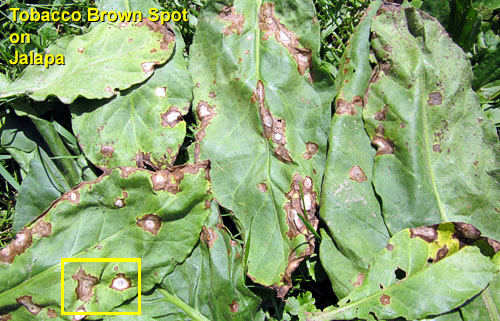
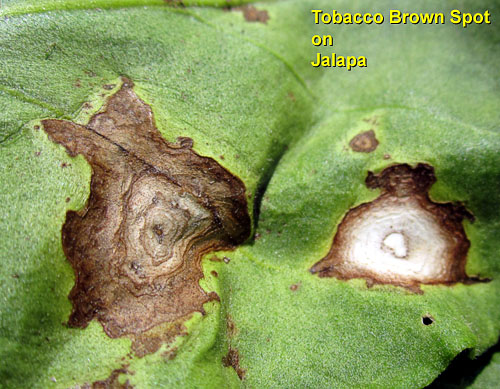
I have a single plant (Jalapa) that showed signs of what I believe to be tobacco brown spot, which is a fungal disease. It appeared first on the lower leaves of the plant, then up to the next higher leaves. I have observed it for about 1 week. Today, I removed all the affected leaves. I assume that the constantly wet weather has encouraged the fungus.

Garden20130705_743_brownSpot_Jalapa_500.jpg


Garden20130705_744_brownSpot_Jalapa_closeup_500.jpg


ipm images" said:
brown spot
Alternaria alternata (Fr.) Keissl.

Description: This fungal disease appears first on the older leaves as circular, brown spots (1/4 to 1 1/4 inches in diameter) with sharply defined margins. Concentric circles (rings) are often noticeable within the spots. As the leaves approach maturity, a yellowish "halo" of varying width often forms around the lesion. Lesions may merge, forming large areas of dead tissue. During humid weather, sporulation of the fungus may be abundant, giving the lesions a black, dusty appearance. Brown spot is most severe as the plant approaches maturity, and the disease progresses from the lower to the upper leaves. Disease severity depends much on the weather, the overall health of the plant, varietal tolerance, and harvest rate.
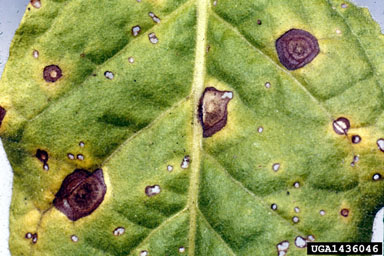
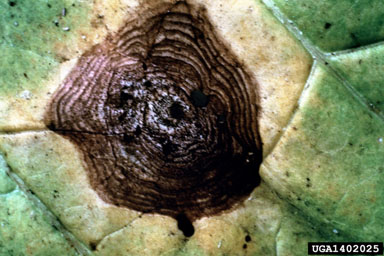
1436046.jpg


1402025.jpg

Supposedly, frog-eye leafspot, on ipmimages.org.
http://www.ipmimages.org/browse/subthumb.cfm?sub=6947&area=62
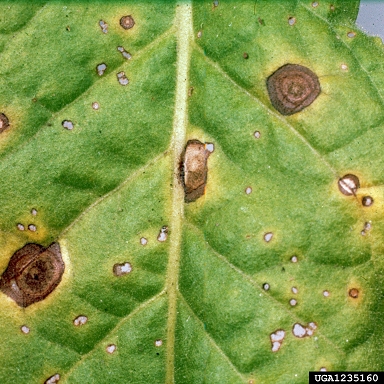
Curiously, also in ipmimages.org is a photo of frog-eye leafspot that bears a different indexing number, but is clearly identical to the first ipm brown spot photo above. Not reassuring. I suppose it doesn't matter, since both brown spot and frog-eye leafspot are fungal.

1235160.jpg

http://www.ipmimages.org/browse/subthumb.cfm?sub=6996&area=62

Bob
 

deluxestogie

Administrator
Staff member
Joined
May 25, 2011
Messages
26,092
Points
113
Location
near Blacksburg, VA
Bob, that also looks very similar to my squash bug damage (I saw the bug). Emre and I posted some pictures in this thread: http://fairtradetobacco.com/showthread.php?2771-Caterpillar-eggs
In my close-up photo, take note of the concentric rings, and the solidity of the central areas of the lesions. Also, the lesions with a central white area are actually white, and not holes, since the photo was taken with the leaves lying on the grass. Also, with brown spot, some of the lesions show a very dark central area, which constitutes the fungal fruiting bodies.

Bob
 

Knucklehead

Moderator
Founding Member
Joined
Oct 18, 2012
Messages
12,777
Points
113
Location
NE Alabama
Thank you for pointing out the differences, I did think the white spots were holes.
 

istanbulin

Moderator
Founding Member
Joined
Oct 16, 2012
Messages
1,290
Points
66
Location
Stockton, CA
istanbulin,
I'll be taking measurements in a week or two (once the size seems stable). I assume the you mean "che" as in Spanish (and the "ch" of "chair" in English) , rather than "che" as in Italian.
Yes, the "ch" of "chair".

When it comes to the fungal problem you have. Most of the fungal plant pathogens show similar symptoms on the leaves but there're little differences between them. I never saw a fungus damage on a tobacco leaf before (here), even in very humid areas like Trabzon. If you have trees like ash, boxelder, catalpa, cherry, elm, holly, locust, magnolia, maple, pear, plum, poplar etc. near to your tobacco patch, they're more sensitive to this fungus than tobacco is. You may check them if they got same damage.

EDIT: If the brown spots don't drop out, it may not be Alternaria.
 

deluxestogie

Administrator
Staff member
Joined
May 25, 2011
Messages
26,092
Points
113
Location
near Blacksburg, VA
The Good, the Bad and the Ugly

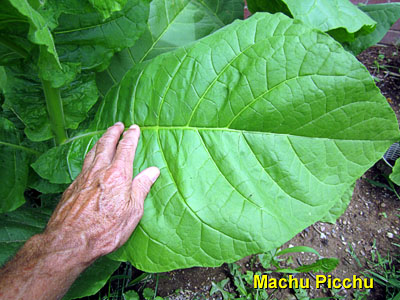
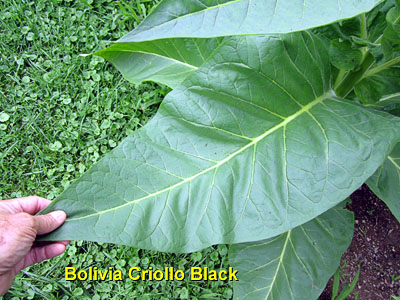
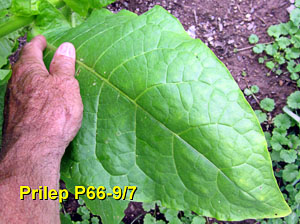
For those areas of the garden (most of it) that drain well, tobacco growth has benefited from the monsoon rains.

Garden20130707_745_BoliviaCriolloBlack_leaf_400.jpg


Garden20130707_746_PrilepP66_9_7_leaf_300.jpg


Garden20130707_757_MachuPicchu_leaf_400.jpg


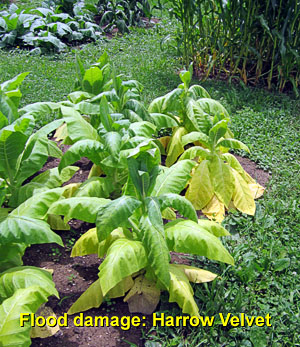
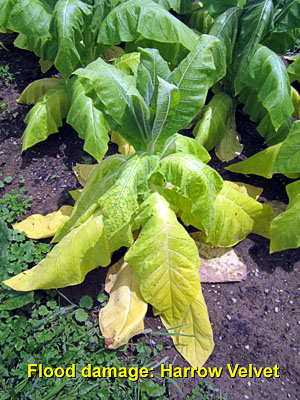
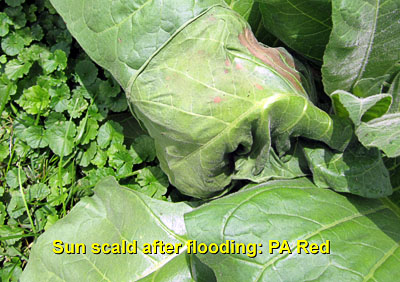
At the bottom corner of the garden, where the drainage is problematic, flooding damage, primarily to the roots, is visible in the Harrow Velvet (burley) and the PA Red.

Garden20130707_747_floodDamage_HarrowBed_300.jpg
Garden20130707_748_floodDamage_Harrow_300.jpg


Garden20130707_749_sunScaldAfterFlood_PARed_400.jpg

Root flooding has caused some of the leaf to fully wilt. Full sun then scalds the leaf tissue.


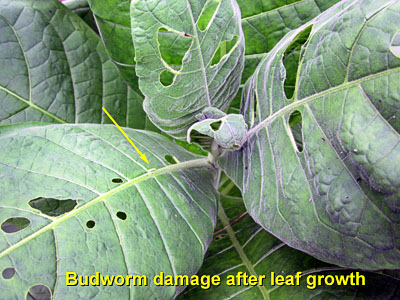
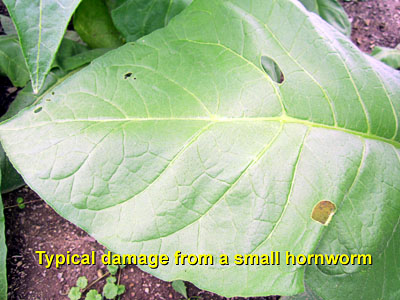
For those who hand pick your pests (vs. spraying), patterns of damage will suggest specific pests.

Garden20130707_752_budwormDamage_400.jpg
Garden20130707_750_Budworm_400.jpg

Budworms primarily attack the tiny leaves of the growth tip (though later, they bore into the seed pods and cause significant seed loss). Once the damaged, tiny leaves grow larger, the damage can be dramatic.

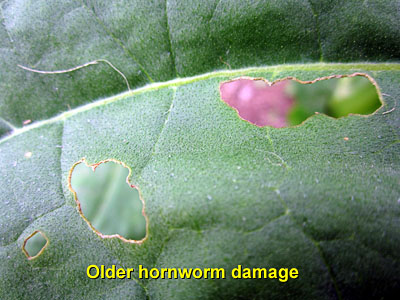
Hornworms, if ignored, can easily consume entire plants. I try to catch them when tiny. To do this, I walk the tobacco, looking for new, small holes, then inspect the underside of the leaf. I'm sure I examine the same hole at least a half-dozen times on different days. Fortunately, as a hole ages (i.e. it's not a recent hole), its margins darken.

Garden20130707_753_hornwormDamage_400.jpg


Garden20130707_755_hornwormDamage_older_400.jpg


Bob
 
Status
Not open for further replies.
Top