deluxestogie Grow Log 2013

Status
Not open for further replies.

deluxestogie

Administrator
Staff member
Joined
May 25, 2011
Messages
26,075
Points
113
Location
near Blacksburg, VA
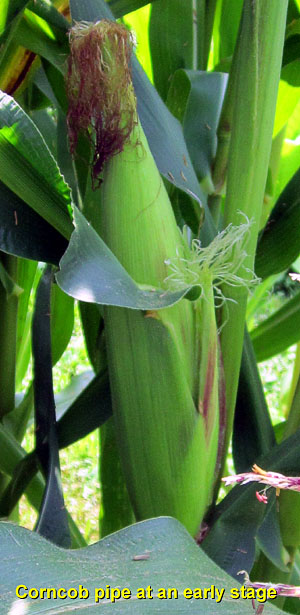
Garden20130718_795_OaxacaCornEar_300.jpg

Embryonic corncob pipe.

56 Orientals in a 5' x 12' bed: 12 Mutki; 22 Çelikhan; 22 Xanthi Yaka 18a. With the narrow bed, I never have to walk between plants. While access to the center is less than idea, I have found it to be reasonably workable. That is, I'll do it the same way next year.
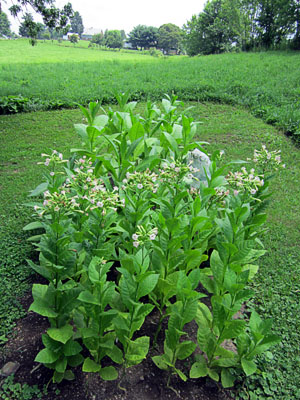
Garden20130718_798_OrientalBed_300.jpg

Mutki in the rear, Çelikhan in the center, Xanthi in the foreground.

The Machu Picchu is generally above 5' now, with budding beginning.
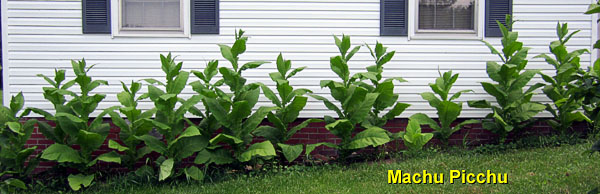
Garden20130718_797_MachuPicchu_600.jpg


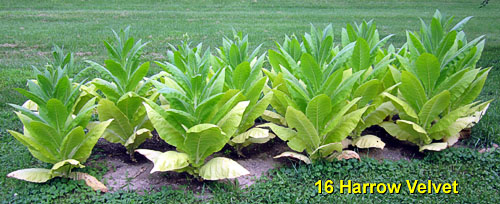
Below is a different view of my Harrow Velvet. I love its color. It will be stalk harvested.
Garden20130718_796_HarrowVelvet_bed_500.jpg


Frenching

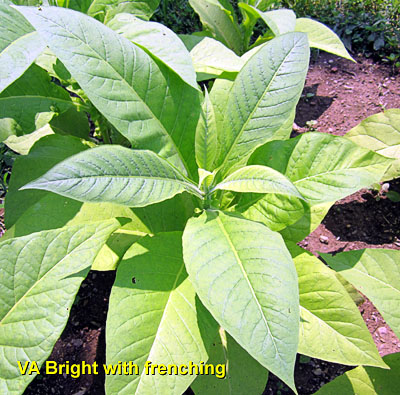
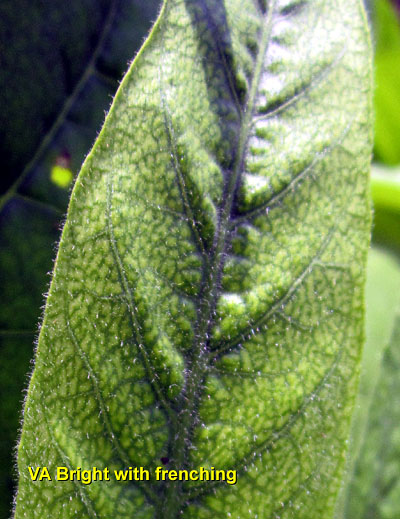
Here is a single plant, within a bed of 16 plants, that demonstrates the metabolic abnormality commonly termed "frenching." Notice that the lower leaves of the plant appear normal, while the top leaves exhibit symptoms of frenching.
Garden20130718_792_VABright_frenching_400.jpg


Garden20130718_791_VABright_frenching_closeup_400.jpg


The subject of frenching, along with some lovely photos, was recently discussed in another thread. The best I can figure out, from available publications, is that the symptoms of frenching result from a single metabolic abnormality that can be triggered by a number of different causes. But the most common cause seems to be from the overgrowth of a bacterium (Bacillus cereus) in soil that presents favorable conditions for its growth (poor drainage, high pH [low acidity]), and is the result of a waste product produced by that bacterium.

Steinberg RA: Production and Prevention of Frenching of Tobacco Grown in the Greenhouse. Plant and Soil: VII no 3 (March 1956) said:
...a definite rise in soil numbers of [Bacillus] cereus accompanied frenching.

Although frenching occurred over the full range of pH suitable for the plant, it was more infrequent [i.e. less frequent] at high acidities (pH 4.6-5.2). The severity of the symptoms tended to be greater at low soil acidity....

[Sodium nitrate] prevented appearance of symptoms in the plant temporarily.

http://link.springer.com/article/10.1007/BF01666124#page-2

University of Kentucky said:

University of Kentucky said:
Frenching is more common in poorly drained and high pH soils.

http://www.uky.edu/Ag/Tobacco/Pages/Frenching1.html

What I find unique is that only a single plant displays symptoms of frenching.

Bob
 

DGBAMA

Well-Known Member
Joined
Feb 10, 2013
Messages
4,418
Points
63
Location
NORTH ALABAMA
The HV is really a good looking plant. Light color should make for easy curing? How does it smoke? may give it a try next year.
 

deluxestogie

Administrator
Staff member
Joined
May 25, 2011
Messages
26,075
Points
113
Location
near Blacksburg, VA
When I sampled BigBonner's Bolivia Criollo Black leaf, I found it to make an excellent full-bodied yet smooth pipe tobacco when only air-cured. In that state, it holds a dull yellow color. After kilning, the color darkens to a light-medium brown, with a less edgy, but less interesting flavor in the pipe.

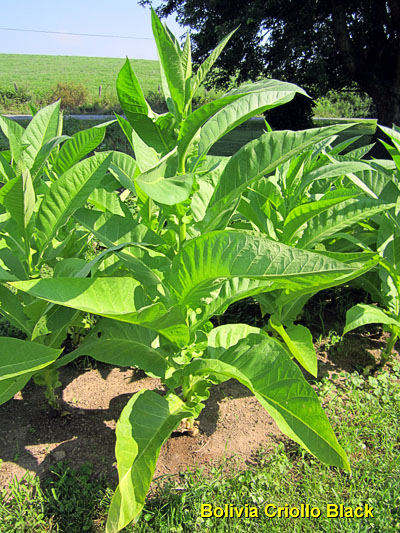
Garden20130719_806_BoliviaCriolloBlack_fullPlant_400.jpg

Now at ~5' in height, this Bolivia Criollo Black produces huge mid leaves, 30" x 15".

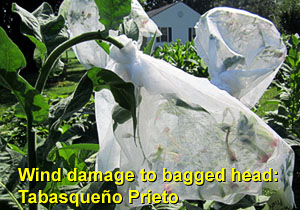
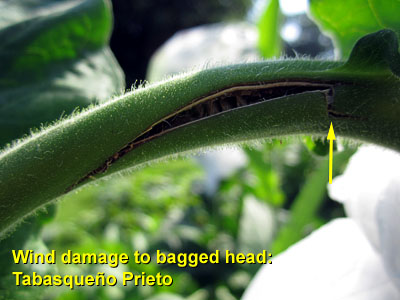
Usually, when the wind tips over just the top of a bagged plant, I find that it has righted itself overnight (with the increased fluid turgor in the stalk. In the Tabasqueño Prieto (Mexico) below, that failed to happen. On inspection, the wind had apparently fractured the top of the stalk. The now tipped blossom head appears to be continuing to grow well.

Garden20130719_800_windDamageBagHead_300.jpg
Garden20130719_802_windDamageBagHead_closeup_400.jpg


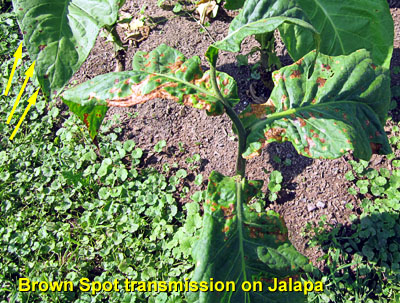
A couple of weeks ago, I removed some Jalapa leaf that had shown the fungal infection, Brown Spot. The upper leaf showed no signs. I allowed that plant to remain in the bed to observe what happened next. Over the interim, all of the upper leaves on this stunted plant developed Brown Spot. That was not surprising. More interesting, and an argument for removing an infected plant from the ground is the observation that leaves from two immediate neighbor plants now show the tiny marks of early Brown Spot (below). My assumption is that the fungal spores from the initially infected plant were able to colonize some of the tiny adventitious injuries in the nearby leaf. As you would guess, I recommend early removal of the entire plant of a Brown Spot infected plant, unless it is almost time to harvest.

Garden20130719_804_brownSpotTransm_Jalapa_400.jpg


NCSU Plant Pathology said:
Because brown spot populations build up higher and higher throughout the growing season, and because aging tissue is more susceptible to the brown spot fungus, plants that remain in the field longer than normal are most damaged by the brown spot disease. Other important conditions that lead to brown spot are continuous tobacco culture, frequent rains, and very sensitive varieties.

This fungus overwinters primarily in tobacco stalks.

Spots produced on the lower leaves form new generations of spores that are splashed and blown onto other leaves. Each of the spores requires moisture to germinate on a tobacco leaf. Therefore, the leaves must be wet. If dry conditions exist, spores cannot germinate and new spots cannot develop.

Infected leaves should be primed as soon as possible to reduce the number of spores available for pathogen spread.

http://www.ces.ncsu.edu/depts/pp/notes/oldnotes/tb3.htm
Judging from my recollection of Jalapa tips during 2012, I would consider Jalapa to be a very sensitive variety. The prolonged bouts of near daily rains have certainly contributed.


Frenching Rerun

me said:
What I find unique is that only a single plant displays symptoms of frenching.
Today, after carefully examining all of my VA Bright, which shares a 12' x 5' bed toward the lower end of the garden with an equal number of Glessnor, I realized that all of the VA Bright--and none of the Glessnor--showed early signs of frenching. While the Glessnor has grown well, the VA Bright has all been generally shorter than in past seasons. I conclude that the VA Bright is more sensitive than the Glessnor to the high moisture conditions, with regard to the growth of Bacillus cereus in that bed.

Next spring, I will add considerable organic matter to the lower beds, and acidify the soil.

And, to add some amusement to the equation:

Phytopathology: 67-930 said:
...Bacillus cereus subsp. mycoides, effectively controlled tobacco brown-spot lesion development in a controlled environment.

http://www.apsnet.org/publications/phytopathology/backissues/Documents/1977Abstracts/Phyto67_930.htm
Bob
 

DonH

Well-Known Member
Joined
Jun 10, 2012
Messages
1,609
Points
0
Location
Massachusetts
I think I'be had frenching in four plants. I acidified a bit but not enough I guess. Thanks for finding this info. I was worried it was a virus.
 

istanbulin

Moderator
Founding Member
Joined
Oct 16, 2012
Messages
1,290
Points
66
Location
Stockton, CA
And the Prileps! I do hope they are a good smoke, since they are incredibly productive, and beautiful plants as well. ...

My Prilep leaves are around 3 inches (approx. 1/5 size of your Prliep leaves). So I thought that they have a mild smoke (lower in nicotine). I just tried the color cured (semi sun cured) Prilep leaves. As a first impression (actually very early because leaves just color cured and non aged) it has a higher nicotine value than most of the other oriental varieties, it's probably around 2.00% to 2.50 %. Smoke is highly aromatic, has a floral scent. It's apparent that a mild kilning season is enough to improve the taste. I think it's suitable for stand alone smoking. This is what I growed, actually every crop in different areas may be different.
 

deluxestogie

Administrator
Staff member
Joined
May 25, 2011
Messages
26,075
Points
113
Location
near Blacksburg, VA
My Prilep (both varieties) are planted at 1.88 sq. ft. per plant (compared to 0.69 sq. ft. per plant for my Xanthi Yaka 18a and Çelikhan). I believe it could easily handle closer spacing, though with the 40+ leaf count, probably not as close as the Xanthi.

The Çelikhan planting area adjoins that of the Mutki, which is planted at 2.5 sq. ft. per plant. The row of Çelikhan plants closest to the Mutki (a row which has more soil available) is about 1/3 taller than the rest of the Çelikhan, with leaf that is about 50% larger. The Çelikhan (unlike the Xanthi) seems to be exquisitely sensitive to spacing, and would probably have benefited from being planted at ~1 sq. ft. per plant.

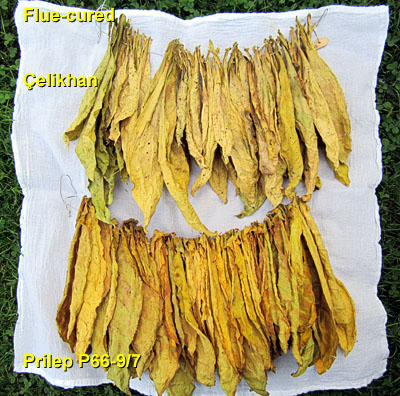
My batch of Çelikhan and Prilep P66-9/7 will come out of the flue-cure Cozy Can this afternoon. I have no idea what to expect. Light and floral? Burnt toast? Stay tuned.

Bob
 

deluxestogie

Administrator
Staff member
Joined
May 25, 2011
Messages
26,075
Points
113
Location
near Blacksburg, VA
Flue-cured Orientals

Garden20130720_808_orientalsFlueCured_400.jpg


This was an interesting experiment. I placed a string each of green Prilep P66-9/7 and Çelikhan (both were primings of lug leaf) into the Cozy Can. Using both seedling heat mats (single 1020 tray size) on continuous heat, I merely regulated the temp by venting the lid with two clothespins. Water was added to the unplugged Crockpot to add some humidity, which I did not measure throughout.

Temps ranged between 90 and 100ºF. Since opening the chamber during the yellowing phase not a problem, I inspected the leaf every 12 hours after the first 48. Despite being two different varieties of tobacco, both strings of leaf required a full 4 days to yellow. (Typical for Virginias is 2.)

Once fully yellowed, the seedling mats were removed from the Cozy Can, the Crockpot set to Hi (100 watts), and plugged into the water heater thermostat attached to the outside of the can. The temp setting was raised on the thermostat in ~10 degree increments at about 6 hour intervals, to reach each stage temp goal (120ºF; 135ºF; 165ºF). I did not check it during the nights. It was on its own. Wilting, leaf drying and stem kill (corresponding to the temp goals) lasted 1 day each, though the final stage lasted an extra 6 hours, since it should have ended during the night. Temps were followed with the grill thermometer attached to the Cozy Can, its probe extending ~4 inches into the interior about 2/3 up the height of the can.

When complete (without looking inside), the Crockpot was unplugged, and the temp was allowed to naturally fall until ambient temperature was reached. The lid was removed. The leaf was misted with water to allow it to be handled, and was wafted directly to my photo studio (front yard) for photographic documentation.

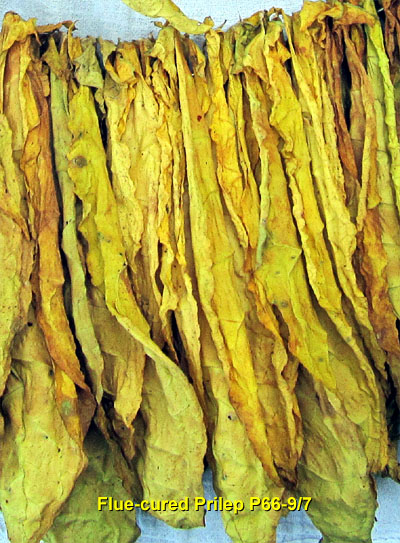
Garden20130720_808_Prilep_P66-9_7_flueCured_400.jpg
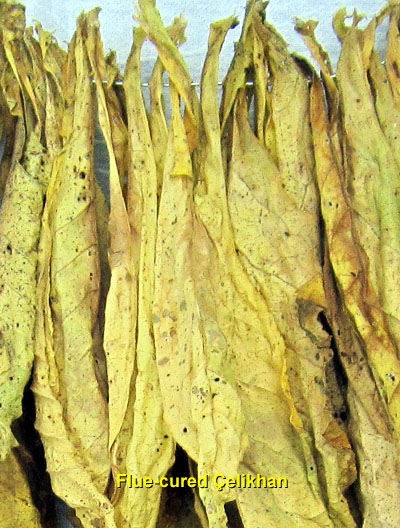
Garden20130720_808_Celikhan_flueCured_400.jpg


The leaf, as it came out of the Cozy Can, offered a mildly sweet aroma suggestive of a bread bakery.

No computers. No digital controllers. No hygrometers. No blowers. No blast gates. No engineering. No welding. No air flow calculations (convection is convection). No fuss. No muss. Couldn't be simpler. While this can be rocket science, it doesn't have to be.

Seriously, if the quantity of leaf is large, then the financial risk is large, and the process needs to be as tightly controlled as possible. For a small batch home grower, the risk is low (and the fun is still great). So I would encourage you to make it high tech if that's an enjoyable challenge for you. Otherwise, quick and dirty and cheap can get the job done.

I tip my hat to leverhead and AmaxB for exploring flue-curing in a more rigorous manner. If you intend to make larger quantities of flue-cured leaf, then their methods will guide the way. My need for flue-cured tobacco is smaller--only for pipe blending. So I take the lazy way--the trash can way. But it's a cozy kind of can.

I will post comments on its taste, etc., after it has aged for several years or less.

Bob
 

holyRYO

Well-Known Member
Joined
Feb 19, 2013
Messages
363
Points
0
You have to sample some now! Three years, come on. Tell us if it actually flue cured (taste sweet), or just yellowed? The peanut gallery needs to know. ;)
 

skychaser

Well-Known Member
Joined
Aug 30, 2012
Messages
1,117
Points
113
Location
NE Washington
Gee Bob, those are a little better looking than those air cured Çelikhan leaves I sent you, aren't they? Mine looked like crap in comparison. Bet it tastes better too. The Prilep is down right beautiful.

I just came in from the field. Gosh, it's hot today. My Prilep has been in the ground now for 50 days. It's planted at 2 foot spacing. It could easily be planted at 18" and still have ample room to grow. The plants are averaging 32" tall with 28 leaves and counting. No signs of budding yet. The leaves are very consistent in size averaging 4 1/2" wide and 9" long.

The Yenidje is a very similar looking plant to Prilep in its plant form and leave shape. It is also at 2' spacing but could be at 12-18" without crowding them. They have been in the ground for 48 days. All have buds and one is blooming today. They are averaging 42" tall with an average of 22 leaves. The leaves are 3" wide and 5-6" long. It seems pretty obvious that these two plants are related. Neither have had any fertilizer and both have been watered as needed, which is about every 3 days. It is 93.4 degrees right now with a relative humidity of 6%. The water doesn't stick around long in this weather.

I'm also growing Japan 8 this year. I know next to nothing about it except that it is an oriental variety. If anyone can give me some info on it, it would be appreciated. It looks very similar to Çelikhan. Maybe I should send you some leaves to put in the cozy can. :D
 

Attachments

  • Japan 8.jpg
    Japan 8.jpg
    75.8 KB · Views: 133

Boboro

Well-Known Member
Joined
Sep 5, 2011
Messages
4,530
Points
83
Location
Wren Mississippi
Know you talkin my language. Kiss ,Thats the way to pull the ppl. in. I cant be'a measurin stuff. I could but I dont want to. now dont get me wrong, I know That keepin reacords is the way to move foward. Most folks just want to make good bacca. We can stream line it. But somedo need the numbers.
 

leverhead

Well-Known Member
Joined
Jan 16, 2012
Messages
3,204
Points
83
Location
Grimes County Texas
Very nice Bob! Flue-cured Orientals! In several years or less I'd be interested to hear how they compare to air or sun-cured. Your description of the smell is interesting! The stems aren't dark like a Virginia leaf, they must have dried much sooner in the process before the temperature was high enough to darken them. Congratulations! It's going to be a long time before this hobby runs out of things that haven't been done before.
 

deluxestogie

Administrator
Staff member
Joined
May 25, 2011
Messages
26,075
Points
113
Location
near Blacksburg, VA
Tell us if it actually flue cured (taste sweet), or just yellowed?
You're confusing the method with your preferred result. It is actually flue-cured, thank you. Might be sweet. Might not. I expect it to resemble sun-cured Oriental (or maybe Turkish Pide [Pee-day] bread).

Sky,
Those Çelikhan are your god-children. Perhaps some of them will pay you a visit.

Boboro,
Keeping it simple is good only if the end product is what we're hoping for. The Cozy Can has a lot of variables that aren't accounted for, and that could spoil a batch. Either the basic flue-cure process is damn simple, or I've been lucky.

leverhead said:
...compare to air or sun-cured.
I believe that the most difficult aspect of sun-curing Orientals is getting them to yellow without retaining the green. The sun exposure is a piece of cake, except for bringing it in when it's about to rain. Four days in a ~95-100º humid can accomplished the yellowing prior to sun-curing. (I seem to recall some stubborn Shirazi requiring nearly a week to yellow in a sun-heated trash can--prior to fire-curing.)

Bob
 
Last edited:

deluxestogie

Administrator
Staff member
Joined
May 25, 2011
Messages
26,075
Points
113
Location
near Blacksburg, VA
It's been several years or less.

No self control. I have no excuse.

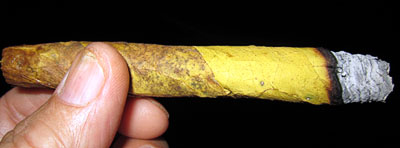
I rolled a tiny cigar of flue-cured Çelikhan blended with flue-cured Prilep P66-9/7, bound and wrapped in flue-cured Çelikhan. The filler even included several leaves with some residual green coloration.

Garden20130720_812_flueCuredOrientalCigar_400.jpg

Cigar made of flue-cured Çelikhan and Prilep.

The taste is slightly sweet, with a lowish pH, and the light floral aroma of a mild Turkish cigarette. The smoke is smooth, with low throat impact. (Definitely smoother than tobacco burned within a rolled-up piece of paper.) The leaf burns well. Nicotine seems low. There is a total absence of the straw and grassy taste that I associate with unaged tobacco.

I have never sampled either of these two Oriental varieties, (well, I did sample some of Skychaser's air-cured Çelikan last fall, but I can't recall the taste details) so I can't compare them to air-cured and sun-cured. On the other hand, I would pay a bunch of money for a supply of this flue-cured Oriental to use in pipe blending. It seems quite similar to authentic, imported Turkish sun-cured tobacco. This is definitely worth the fuss to make it.

This stuff is really good!

I'll start another batch of it (both of them) in the morning.

Bob
 

deluxestogie

Administrator
Staff member
Joined
May 25, 2011
Messages
26,075
Points
113
Location
near Blacksburg, VA
Glad to hear that a yellow cigar is better than yellow snow. Lol.
Snow?

Bob
how much time do you age before smoking?
I have some varieties that are now ~3 years old. Kilned leaf often needs 1-3 weeks or more to settle down. Purely air-cured leaf may require 9 months or more before it's ready.

Although flue-cured tobacco does indeed age further when kilned, the process yields a somewhat darker leaf that has lost a bit of its sweetness. For flue-cured, the first 2 to 3 weeks beyond the flue-cure bring about a noticeable change.

Bob
 
Status
Not open for further replies.
Top