How are leaves flattened before ageing and storage?

deluxestogie

Administrator
Staff member
Joined
May 25, 2011
Messages
26,551
Points
113
Location
near Blacksburg, VA
If you are simply flattening the leaves for storage, then no pressure, other than your fingertips, should be required. If you are pressing a stack of leaf into solid block, then then 10 to 30 psi (pounds per square inch) is appropriate.

Bob
 

UmbriaFarmer

Well-Known Member
Joined
Feb 18, 2026
Messages
112
Points
43
Location
Umbria Italy
If you are simply flattening the leaves for storage, then no pressure, other than your fingertips, should be required. If you are pressing a stack of leaf into solid block, then then 10 to 30 psi (pounds per square inch) is appropriate.

Bob
No, deffo not trying to make flake, just wanted to age it like those pressed stacks you get when you buy froglegged filler from WLT etc, so will just use light pressure. Thank you again!
 

deluxestogie

Administrator
Staff member
Joined
May 25, 2011
Messages
26,551
Points
113
Location
near Blacksburg, VA
When I visited the WLT warehouse in Akron, Ohio, some years ago, what I observed was that clumps of leaf were pried from a purchased bale, sprayed with water, then allowed to soften a bit. It was then separated and flattened by hand. This was allowed to dry-down, then weighed and slipped into their bags. Nothing magical.

Bob

EDIT: Another point is that frog-legged leaf was frog-legged prior to the seller packing it into bales, since the import taxes are based on weight. The frog-legging served to reduce the tax per leaf.
 

UmbriaFarmer

Well-Known Member
Joined
Feb 18, 2026
Messages
112
Points
43
Location
Umbria Italy
When I visited the WLT warehouse in Akron, Ohio, some years ago, what I observed was that clumps of leaf were pried from a purchased bale, sprayed with water, then allowed to soften a bit. It was then separated and flattened by hand. This was allowed to dry-down, then weighed and slipped into their bags. Nothing magical.

Bob

EDIT: Another point is that frog-legged leaf was frog-legged prior to the seller packing it into bales, since the import taxes are based on weight. The frog-legging served to reduce the tax per leaf.
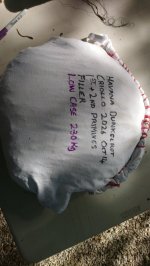
Yes, and I've had them when they hadn't been separated but we're still a chunk with the individual leaves still stuck together. This is what I intend to reproduce with my old pillowcase mini bales.
 

Hayden

Well-Known Member
Joined
Oct 31, 2020
Messages
184
Points
93
Location
Germany
I did take a baking tray and put a 5kg weight on it while the leaf was in medium casw. It gets the job done and the leaf is flat. I reorganized every plastic bag this way.
 

StoneCarver

Bureau for Paranormal Research and Defense
Joined
Aug 26, 2025
Messages
349
Points
93
Location
Winston-Salem,NC
When I said stone brick, I was really just trying to describe the shape. They aren't big, maybe 3"x3"x5" and maybe not even quite that big. I've found them to be real handy as a sort of third hand when I'm stretching leaf out to cut it for use as binder or wrapper because they have flat sides that are smooth/polished and hence will not tear the tobacco like a rough stone would do. Why do I have soapstone like this? Well, https://forum.wholeleaftobacco.com/threads/show-us-your-homemade-pipes.7426/post-228574

Bob makes a good point that too heavy of a weight could inadvertently press the tobacco like a plug and that wouldn't be desirable for cigar tobacco particularly binders and wrappers. It really only needs to be enough weight to hold the leaf down so it doesn't wrinkle too much when drying out. That's why I was thinking of cardboard with my soapstone bricks to keep the tobacco from pushing the cardboard up rendering the cardboard useless. Salt on a bird's tail doesn't keep the bird from being able to fly either. I do need to decide if I want to frog leg before flattening or wait till I'm ready to roll the tobacco into a cigar. I'm not sure I want those thick mid ribs in the stack of leaves whilst they are being flattened and drying out.
 
Last edited:

UmbriaFarmer

Well-Known Member
Joined
Feb 18, 2026
Messages
112
Points
43
Location
Umbria Italy
When I said stone brick, I was really just trying to describe the shape. They aren't big, maybe 3"x3"x5" and maybe not even quite that big. I've found them to be real handy as a sort of third hand when I'm stretching leaf out to cut it for use as binder or wrapper because they have flat sides that are smooth/polished and hence will not tear the tobacco like a rough stone would do. Why do I have soapstone like this? Well, https://forum.wholeleaftobacco.com/threads/show-us-your-homemade-pipes.7426/post-228574

Bob makes a good point that too heavy of a weight could inadvertently press the tobacco like a plug and that wouldn't be desirable for cigar tobacco particularly binders and wrappers. It really only needs to be enough weight to hold the leaf down so it doesn't wrinkle too much when drying out. That's why I was thinking of cardboard with my soapstone bricks to keep the tobacco from pushing the cardboard up rendering the cardboard useless. Salt on a bird's tail doesn't keep the bird from being able to fly either. I do need to decide if I want to frog leg before flattening or wait till I'm ready to roll the tobacco into a cigar. I'm not sure I want those thick mid ribs in the stack of leaves whilst they are being flattened and drying out.
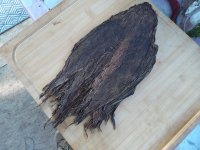
Well I actually got on today and processed the first 10 or so hands that had been fermenting for 6 weeks and although fairly time consuming, it turned out to be much easier than I thought. As there was very little of wrapper quality, I decided to frogleg everything because, as you commented on, it wasn't working out well leaving the midribs in because they were messing up the stacks due to their size. So I put binder in one stack and filler in the other, worked each leaf through my hands to get it fairly flat, then just pressed the two piles under large wooden chopping boards. Just the weight of the boards was plenty to flatten the leaf well. Now I'm going to leave it out for a few days til I'm happy they're dry enough to avoid mould, then will store away for ageing.
 

Attachments

  • 20261001_152112.jpg
    20261001_152112.jpg
    326 KB · Views: 12
  • 20261001_152045.jpg
    20261001_152045.jpg
    261.3 KB · Views: 12

StoneCarver

Bureau for Paranormal Research and Defense
Joined
Aug 26, 2025
Messages
349
Points
93
Location
Winston-Salem,NC
So, it sounds like frog legging before flattening worked well for you? Do you think it would have been more challenging to leave the mid rib in?
 

UmbriaFarmer

Well-Known Member
Joined
Feb 18, 2026
Messages
112
Points
43
Location
Umbria Italy
So, it sounds like frog legging before flattening worked well for you? Do you think it would have been more challenging to leave the mid rib in?
I tried but they just didn't stack or compress well. I don't know if you've figured out the quick rib removal (around your wrist) but it literally takes about 3 seconds and needs no tools. But nonetheless it took me about 2 hours to de-rib, stretch out and press those 8 hands (200 leaves). Totally worth it though. Today the stacks have dried nicely and won't mould, but I'm not going to stitch them up in the mini bales til the second priming is out of the kiln and prepped - another week yet. That was a much bigger priming then a week after that the biggest, the 3rd will be ready too. FYI, 200 leaves gave a froglegged weight of precisely 1kg. The only ones I won't be froglegging are the wrapper leaves as I shall be handling those precious items with kid gloves...
 

StoneCarver

Bureau for Paranormal Research and Defense
Joined
Aug 26, 2025
Messages
349
Points
93
Location
Winston-Salem,NC
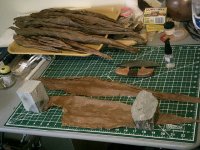
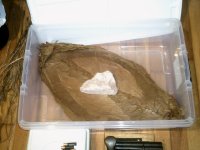
I spent all Saturday and Sunday afternoon flattening leaves. This is tedious work but worth it. I figure the way I did it will make it easier later on to grade the leaves between wrapper, binder, filler. I had some stages to it. I decided to cut the mid ribs out entirely. It was pretty easy since the leaves had folded in on themselves during curing. Before cutting I brought the leaves up to high case then fully folded the leaves. Doing so also began flattening the thickest part of the side veins that connected with the mid rib. As you can see in the first picture, I used stone weights to hold the ends of the leaf down whilst I flattened the main part of the leaf with my hands. Mainly, I was trying to flatten the side veins. Doing so, the lamina followed. With that done, I placed the leaf under a couple plastic cigar molds just to keep the side veins flat whilst they adjusted to being flat. I began a preliminary stack under the cigar molds. Then when I got a batch done, I'd put the preliminary stack in the box on the final stack as you can see in picture 2. In that picture you can see I kept both sides of the leaves in their respective stack. There is a piece of plexiglass on the stack and a stone to weigh it down, again for just enough pressure to keep the side veins flat. In the final stack, I'm letting them dry out. I want the side veins to fully dry out in this position. Then I'll rehydrate leaves. I'm hoping all this flattening will make work much easier latter on.
Flattening1.JPG
Flattening2.JPG
I think I only left them under the plexiglass for 24hrs. It wasn't long. But the leaves are still drying out.
Btw: the variety I'm working with here is Red Rose. I have to admit the box aroma does suggest roses.
 

UmbriaFarmer

Well-Known Member
Joined
Feb 18, 2026
Messages
112
Points
43
Location
Umbria Italy
I spent all Saturday and Sunday afternoon flattening leaves. This is tedious work but worth it. I figure the way I did it will make it easier later on to grade the leaves between wrapper, binder, filler. I had some stages to it. I decided to cut the mid ribs out entirely. It was pretty easy since the leaves had folded in on themselves during curing. Before cutting I brought the leaves up to high case then fully folded the leaves. Doing so also began flattening the thickest part of the side veins that connected with the mid rib. As you can see in the first picture, I used stone weights to hold the ends of the leaf down whilst I flattened the main part of the leaf with my hands. Mainly, I was trying to flatten the side veins. Doing so, the lamina followed. With that done, I placed the leaf under a couple plastic cigar molds just to keep the side veins flat whilst they adjusted to being flat. I began a preliminary stack under the cigar molds. Then when I got a batch done, I'd put the preliminary stack in the box on the final stack as you can see in picture 2. In that picture you can see I kept both sides of the leaves in their respective stack. There is a piece of plexiglass on the stack and a stone to weigh it down, again for just enough pressure to keep the side veins flat. In the final stack, I'm letting them dry out. I want the side veins to fully dry out in this position. Then I'll rehydrate leaves. I'm hoping all this flattening will make work much easier latter on.
View attachment 61226
View attachment 61227
I think I only left them under the plexiglass for 24hrs. It wasn't long. But the leaves are still drying out.
Btw: the variety I'm working with here is Red Rose. I have to admit the box aroma does suggest roses.
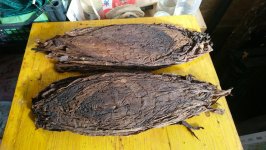
I love reading your stuff, for although on opposite sides of the world we are occupied by the exact same work! I am doing this every day... mornings I get to the farm, put in my obligatory shift on constructing our summer cabin, which I've now been doing for exactly a year (see pic). This keeps my wifey onside re the amount of time I spend each afternoon doing my 'baccy. I take four hands out of the kiln in the morning, give them a light spritzing as the tips are verging on crispy, wrap them in a garbage bag and leave them until after lunch (that's a pretty much obligatory event in Italy, you're never allowed to skip lunch here). I'm taking a slightly different leaf prep approach to you as I'm grading first. I cut the colour-coded ligature off the hand and take a leaf, unfurl it, work it out to the edges, grasp and stretch it carefully in both planes and if it's shredded or got holes in it, I frogleg it and place it in the filler pile. If it has potential as either binder or wrapper I leave the rib in and place it in the other pile. It takes me about 90 mins to do 4 hands, thus just under a minute per leaf. When I've done the four hands I layer the filler in layers about 16" square, north south then east west, then place a thick plywood board over it and weigh it down with a bucket that contains about a gallon of paint. I place the binder/wrapper leaves in a single stack, two stacks side by side, on top of the first piece of plywood, cover with another piece and the bucket. Then I go home and bunch 10 cigars. I the morning they look like they are in the pics. Each priming is going to be sewn up in my mini bales to be put away for 6 months minimum. Rinse and repeat. I still have about 40 more hands to process.

 

Attachments

  • DSC_0037.JPG
    DSC_0037.JPG
    248.6 KB · Views: 7
  • DSC_0006.JPG
    DSC_0006.JPG
    226 KB · Views: 7
  • DSC_0007.JPG
    DSC_0007.JPG
    208.4 KB · Views: 7

mbatini

Well-Known Member
Joined
Oct 20, 2020
Messages
85
Points
83
Location
Terni Italy
I love reading your stuff, for although on opposite sides of the world we are occupied by the exact same work! I am doing this every day... mornings I get to the farm, put in my obligatory shift on constructing our summer cabin, which I've now been doing for exactly a year (see pic). This keeps my wifey onside re the amount of time I spend each afternoon doing my 'baccy. I take four hands out of the kiln in the morning, give them a light spritzing as the tips are verging on crispy, wrap them in a garbage bag and leave them until after lunch (that's a pretty much obligatory event in Italy, you're never allowed to skip lunch here). I'm taking a slightly different leaf prep approach to you as I'm grading first. I cut the colour-coded ligature off the hand and take a leaf, unfurl it, work it out to the edges, grasp and stretch it carefully in both planes and if it's shredded or got holes in it, I frogleg it and place it in the filler pile. If it has potential as either binder or wrapper I leave the rib in and place it in the other pile. It takes me about 90 mins to do 4 hands, thus just under a minute per leaf. When I've done the four hands I layer the filler in layers about 16" square, north south then east west, then place a thick plywood board over it and weigh it down with a bucket that contains about a gallon of paint. I place the binder/wrapper leaves in a single stack, two stacks side by side, on top of the first piece of plywood, cover with another piece and the bucket. Then I go home and bunch 10 cigars. I the morning they look like they are in the pics. Each priming is going to be sewn up in my mini bales to be put away for 6 months minimum. Rinse and repeat. I still have about 40 more hands to process.
Hi @UmbriaFarmer: " (that's a pretty much obligatory event in Italy, you're never allowed to skip lunch here)" ---- you know, without lunch your leaves could come out crispy and not flattened. Great job!
 

StoneCarver

Bureau for Paranormal Research and Defense
Joined
Aug 26, 2025
Messages
349
Points
93
Location
Winston-Salem,NC
I thought about grading whilst flattening but I don't really have the space. Its easier for now to keep everything in the same pile and sort later. Now that I have that done, I'm resting on my laurels for a couple days. Besides, tonight is the local astronomy club meeting which I ought to attend. Last weekend's hurricane literally blew away our club's observation events. So, we may need to replan something. Gotta satisfy that eyeball to lens addiction. "I'm seeing stars!" I need to clean and tweak my kiln so that I can get the next batch of tobacco going. I have 4 to 6 more batches to do, like what I finished last weekend. That's not counting the sucker crop which I don't know how many kiln loads that will constitute. I'll be kilning stuff for the next year I'm sure. Next up for me to learn is bunching. I've been watching a lot of videos but I know its about developing that feel for getting the right amount of tobacco in the bunch. For the few I've done so far, I've tended to not use enough leaf and the draw is a bit too loose and the cigar burns too fast.

BTW: nice house! Not many houses in the US have tiled roofs such as yours. I find it interesting how different cultures sometimes have their main meal at noon and how that affects their daily lives.
 
Top