It looks great like the Darkstar. What are the leaf varieties and proportions? How did it turn out?I‘ll call this Dark Broken. View attachment 54127
I tried to make my own dark fired flake. So far so good but letting it rest some more.

It looks great like the Darkstar. What are the leaf varieties and proportions? How did it turn out?I‘ll call this Dark Broken. View attachment 54127


Can't believe I overlooked this thread, Genius! Think I've been overthinking the whole Cavendish process. Good work man!View attachment 54125
After six hours of steaming
Agree! This is how knowledge is best shared amongst hobbyists. Will be trying out home made cavendish with this recipe. One question for @Juxtaposer- does the process kill the nicotine in your opinion? I find that to be a potential drawback.Can't believe I overlooked this thread, Genius! Think I've been overthinking the whole Cavendish process. Good work man!
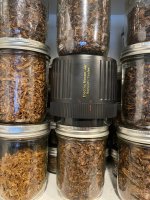
I want try a 12 year old jar of Virginia leaf, do you think it would age well after shredding? The strips are probably 2.2mm wide. I have selected the thick leather like leaves from the thin and shredded separately.How I process my whole leaf tobacco purchases.
Step 1 Storing
Things you will need;
1# tobacco bag
scissors
two 16oz wide mouth jars
Cut the bag across to open on the stem side
take out one leaf keeping the rest in the bag as to not loose case (moisture)
fold the leaf along the stem with the leaf bottom on the outside, this will expose the stem
hold the stem with one hand while pinching off the two leaf sides with the other
this is done holding the thick end of the stem while levering the pinch of leaf off
lever off only what you have pinched and do not continue to pull apart further
take another pinch further gripping veins as you go along levering the leaf off the stem
when you reach towards the tip of the leaf and the stem is the size of veins you can continue by tearing the leaf in half You now have two halves of one leaf with no stem
fold the leaf half to fit the jar so that most of the leaf will be horizontal in the jar
you may fold both halves at the same time and have the top or bottoms of the leaves facing in certain directions etc. but what is most useful is to fold all the leaves in the SAME way for convenience of use
press the folded leaves firmly in the jar and cover to preserve case
repeat until all the leaves have been de-stemmed
press the tobacco firmly into the jars using your thumbs and be sure there will be no tobacco on the rim of the jar when the lid is finally placed keep the jar full of tobacco in a dark and temperature stable place
notes;
de-stem and jar as soon as possible to prevent mold
larger veins can be removed if desired
stems can be left to dry and used for products other than pipe tobacco
any mold or mildew can be picked or wiped off
sun spots or discolorations of the leaves can be ignored
tobacco leaf is normally sold at a good case though it’s possible that it could be too wet or too dry
I would question any seller that ships tobacco that is too wet as it is very unlikely to happen
if the tobacco is to dry for folding without cracking you can spray with a little distilled water to rehydrate
a jar full of compressed tobacco leaf will use up available oxygen quickly so mold is not likely to grow
a twelve year old jar of folded Virginia leaf is an amazing thing burley however is simply preserved
four 8oz wide mouthed jars could be used instead of two 16 oz any smaller would not be practical

Honestly no tobacco “needs” to be cased and any tobacco can be cased even those you mentioned. Casing can be done at any time you could even dry out a commercial mixture and re-case it with whatever you would like. There are certainly tobaccos that unless expertly blended you will want apply a casing other than just water. This does make them easier to work with. Have fun learning! I still am, in fact I just cased a bowls worth of tobacco with apple cider vinegar. Not enough sour to put up with the acrid taste it brings. It also neutralizes some flavors so I will not be moving forward with it.Thank you so much! I'm new to this and was wondering why my blends tasted like shredded cardboard. The only one that was palatable was a blend made with cavendish, perique, and latakia. I didn't know about casing the leaves, so I ran my de-veined leaves through an antique tobacco shredder and jarred them. They're packed in there pretty tight and I haven't seen any indication of mold. In the future, should I case the leaves before shredding and jarring? I'm assuming I can case afterward, but I'm looking for advise. I read on another blog that the only tobaccos that don't need to be cased are perique, latakia, cavendish, and possibly fire cured. Your thoughts? Now that the door to this hobby (or method to part with my money and time) has been opened I'm doing a lot of reading and research. Thanks again, and I appreciate any advice!!!
There are a few I know who are experimenting with fermented products such as kombucha to case tobaccos. The results could be interesting but “fermentation“ in tobacco is not of the same type. Most fermentation requires salt to control unwanted growth and salt would not be wise to smoke in such amounts. Wine, beer, and other fermented alcohols would suit tobacco better. I certainly have given some thought to this type of fermentation in tobacco. I have concluded that it surely has been tried and that if it actually did yield any beneficial results it would already be seen in some tobacco products. I would like to keep it simple. For the moment I will be concentrating on fruit for the added enzymes and microbes. Raisins seem promising having a high amylase content.I somehow missed this fantastic thread, thanks for sharing all this information. Keep us posted on the perique and coin cut. Fruit juice for casing Vas is interesting, it would increase the acidity of the leaf, add sweetness and pineapple juice in particular has a lot of enzymes that break down proteins, not to mention the microbes that are already present. Have you tried fermenting the pineapple juice for a couple of days and then casing with that? That would have a stronger culture of yeasts and lactic acid bacteria to go to work on the tobacco.
I've been homebrewing and making kombucha for years, so this is something I'm excited to try out. Casing with pickle juice would probably be a bad idea though, as you say. Pineapple juice is so acidic that only yeasts and lactic acid bacteria will really grow in it anaerobically. It would be like casing with tepache, but when you use it at two days that should be the peak of microbial concentration in the juice so any post-casing fermentation in the leaf would be getting a kickstart.There are a few I know who are experimenting with fermented products such as kombucha to case tobaccos. The results could be interesting but “fermentation“ in tobacco is not of the same type. Most fermentation requires salt to control unwanted growth and salt would not be wise to smoke in such amounts. Wine, beer, and other fermented alcohols would suit tobacco better. I certainly have given some thought to this type of fermentation in tobacco. I have concluded that it surely has been tried and that if it actually did yield any beneficial results it would already be seen in some tobacco products. For the moment I will be concentrating on fruit for the added enzymes and microbes. Raisins seem promising having a high amylase content.

We discuss any variety of tobacco, as well as numerous approaches to growing, harvesting, curing, and finishing your crop. Our members will attempt to provide experience-based answers to your questions.


