In pursuit of the perfect Burley Flake

PvtPublic

Well-Known Member
Joined
Jan 20, 2026
Messages
83
Points
33
Location
Montana
This post will serve as my journal in my pursuit of the perfect Burley flake, for my future reference and as a means to inform others.

I've harvested a good amount from my four Harrow Velvet burleys this year and I'd like to make a burley flake. What I seek is a bit of guidance to make the best first attempt. I will begin my first attempt by making a blend from all the leaves with a ratio of (1)tips: (3)2nd priming: (2)1st priming. At this time, I haven't decided on an overall amount as not all of of my leaves are finished curing. I'm not interested in aromatics, but I would like to dial in the right casing to bring out the best in these fantastic leaves. After pouring over this forum many times over, I believe I know a starting point, but I'd like some experienced input before pulling the trigger.
For my casing, I'm considering bourbon for the base, with cocoa powder and licorice root. The first application will use reducing sugars to react with FAA, but at this time I am unsure of the time needed to achieve this. As honey is a mix of reducing sugars, I will use it first. For the second application, I will use molasses, a non-reducing sugar.
This is where I'd like a little guidance. I'm not sure of the ratio of these ingredients to make the casings. I've seen some members talk about making licorice root tea, but has anyone made an extract instead? I also see a lot about making casings without much talk about quantity or ratio. When I do see it, it's usually for Virginias or blends of multiple varieties and nothing specific to burleys, orientals, etc.
If I were to make a pint of casing (using a pint of bourbon), would a good starting point be a tablespoon of cocoa powder and a teaspoon of licorice extract (or a tablespoon of chopped and dried root)? How about honey/molasses, would a tablespoon of either be sufficient?
 

Juxtaposer-

Well-Known Member
Joined
Jun 11, 2024
Messages
237
Points
93
Location
Las Vegas
Firstly you will discover that you wil want to ferment/kiln/age the Burley. Meanwhile you could soak toasted cacao nibs and licorice root pieces in your bourbon. How much you ask. I would say as much as you can possibly fit into the bourbon. How much sugar? I don’t know what FAA is but I have found that you would need to make multiple applications of sprayable sugars to even come close to the 13% by weight that would be near the maximum you might add.
 

PvtPublic

Well-Known Member
Joined
Jan 20, 2026
Messages
83
Points
33
Location
Montana
Firstly you will discover that you wil want to ferment/kiln/age the Burley. Meanwhile you could soak toasted cacao nibs and licorice root pieces in your bourbon. How much you ask. I would say as much as you can possibly fit into the bourbon. How much sugar? I don’t know what FAA is but I have found that you would need to make multiple applications of sprayable sugars to even come close to the 13% by weight that would be near the maximum you might add.
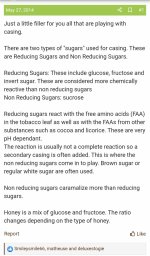
FAA is Free Amino Acids. It's mentioned here:1000004942.jpg

For 13% sugar by weight, I imagine that anything higher results in an acrid burnt sugar experience. My goal is to enhance the Burley flake, not sweeten it. So at what point would the sweetness change from subtle to too much would be a subject worth exploring. At least I know that 13% is the ceiling, but I have to ask; 13% of total weight or of the tobacco weight or of the casing weight? I will explore this on some WLT burley.
I suppose it might be worth mentioning that I had planned on kilning my burley beforehand.
 

Juxtaposer-

Well-Known Member
Joined
Jun 11, 2024
Messages
237
Points
93
Location
Las Vegas
Yes 13% of the total weight tobacco and casing is an example of an excessive amount of sugars that could be used. A typical amount of sugar I use would be a casing that is up to 50% sugar sprayed on either lightly or heavily etc. For this reason I do not end up with a measured amount of sugars. All I know is that the amount is nowhere near what might be considered maximal.
i don’t quite understand the secondary non reducing casing value other than in caramelization. Will you then be steaming or stoving for this?
 
Last edited:

johnny108

Well-Known Member
Joined
Feb 23, 2023
Messages
1,228
Points
113
Location
Germany
At what point would the sweetness go from being a flavor enhancement to an unpleasant, sugary taste?
That depends on your own palate.
When I worked in a brewery, I had a massive sweet tooth, as a result, when I took the beer judges test, I had trouble identifying the “sweetened” sample- 1-5 grams of sugar dissolved in one liter of water. The same was done with salt, and vinegar- these I picked out instantly, but since I was used to eating candy, I could barely taste sugar in the water.
Another guy taking the test was diabetic, and could instantly recognize any sweetness, because he never ate candy, or anything with sugar in it. He was more sensitive to it.
I no longer have the sweet tooth, and can enjoy drier styles of beer, wine, etc.

Personally, to avoid excess sweetness in my tobacco, I would case small samples with 1, 2, 3, and 4% sugar solutions, test burn/taste them, and see what I like. Small 1-5 gram tobacco samples (a pipe bowl full of each), with a syringe/pipette/eye dropper filled with 1-4% sugar solutions, adding the same measured amounts to each sample, then letting them dry down to smokable case, and trying them- weakest to strongest.
I’d start with the weakest, to try and keep my palate’s sensitivity from being drowned out by a heavy sugar content of a stronger sample.

The first decision would be what sugar to use. I would go with a refined, pure type of sugar, to prevent floral/honey or dark mineral flavors (molasses) from changing the tobacco flavor.
 

StoneCarver

Bureau for Paranormal Research and Defense
Joined
Aug 26, 2025
Messages
360
Points
93
Location
Winston-Salem,NC
Firstly you will discover that you wil want to ferment/kiln/age the Burley.
I was just about to ask "case then age/kiln" or "age/kiln then case".

This discussion is reminding me of one we had in another thread about what is a casing vs a topping. I'd provide a link but I'm not finding it right now.
We had discussed that a casing is something that changes the chemistry of the tobacco and smoke whereas a topping only adds flavor- or something like that.
I think that's important for a person to keep in mind whilst they are putting together a casing recipes. That is the ingredients which are there for chemical actions vs those we are adding for flavor/aroma enhancement/additive.
 

PvtPublic

Well-Known Member
Joined
Jan 20, 2026
Messages
83
Points
33
Location
Montana
Yes 13% of the total weight tobacco and casing is an example of an excessive amount of sugars that could be used. A typical amount of sugar I use would be a casing that is up to 50% sugar sprayed on either lightly or heavily etc. For this reason I do not end up with a measured amount of sugars. All I know is that the amount is nowhere near what might be considered maximal.
i don’t quite understand the secondary non reducing casing value other than in caramelization. Will you then be steaming or stoving for this?
Thanks, that helps a lot! I'm with you there, I dont understand the purpose of non-reducing sugars either apart from what was mentioned, which didn't elaborate. I will be heating under pressure, using a noodle press and my dehydrator set to 130*F. I place the press in a ziploc so it doesn't dry out.
At what point would the sweetness go from being a flavor enhancement to an unpleasant, sugary taste?
That depends on your own palate.
Right, I'm looking for the threshold and dialing it back a hair since I want the benefit of the sugar without perception.
When I worked in a brewery, I had a massive sweet tooth, as a result, when I took the beer judges test, I had trouble identifying the “sweetened” sample- 1-5 grams of sugar dissolved in one liter of water. The same was done with salt, and vinegar- these I picked out instantly, but since I was used to eating candy, I could barely taste sugar in the water.
Another guy taking the test was diabetic, and could instantly recognize any sweetness, because he never ate candy, or anything with sugar in it. He was more sensitive to it.
I no longer have the sweet tooth, and can enjoy drier styles of beer, wine, etc.
My beer judging test was vastly different!
Personally, to avoid excess sweetness in my tobacco, I would case small samples with 1, 2, 3, and 4% sugar solutions, test burn/taste them, and see what I like. Small 1-5 gram tobacco samples (a pipe bowl full of each), with a syringe/pipette/eye dropper filled with 1-4% sugar solutions, adding the same measured amounts to each sample, then letting them dry down to smokable case, and trying them- weakest to strongest.
I’d start with the weakest, to try and keep my palate’s sensitivity from being drowned out by a heavy sugar content of a stronger sample.

The first decision would be what sugar to use. I would go with a refined, pure type of sugar, to prevent floral/honey or dark mineral flavors (molasses) from changing the tobacco flavor.
Interesting. Very valid point since I'd like to keep it burley-centric. I will use molasses in different quantities, however, to see how it affects the flavor, mouthful, etc.
I was just about to ask "case then age/kiln" or "age/kiln then case".

This discussion is reminding me of one we had in another thread about what is a casing vs a topping. I'd provide a link but I'm not finding it right now.
We had discussed that a casing is something that changes the chemistry of the tobacco and smoke whereas a topping only adds flavor- or something like that.
I think that's important for a person to keep in mind whilst they are putting together a casing recipes. That is the ingredients which are there for chemical actions vs those we are adding for flavor/aroma enhancement/additive.
I might have to make split batches to put them side-by-side to see how casing before and after works. This discussion will not consist of toppings, as I'm not interested in aromatics and that is not the objective of this discussion. I would like to strictly discuss casings for burley for the purpose of making pure burley flake, so those ingredients for chemical reactions are going to be the forefront, but flavor enhancement ingredients will also be discussed.
 

PvtPublic

Well-Known Member
Joined
Jan 20, 2026
Messages
83
Points
33
Location
Montana
It may be that the added acidity of a casing would interfere with the oxidative processes that kilning stimulates. I do wonder if a fresh fruit casing that is high in amylase might be beneficial.
Oxygen is irrelevant to the starch conversion of amylase. What do they contribute to the kilning process? I'm interested to know what amylase enzymes are at work and what they provide. Citric acid is an antioxidant, present in many fruits, which would inhibit said oxidative process. However, pomme and stone fruits are susceptible to oxidation. Perhaps some experimenting is in order. I may have opened a very large can of worms that I'm going to enjoy fishing with.
 

Juxtaposer-

Well-Known Member
Joined
Jun 11, 2024
Messages
237
Points
93
Location
Las Vegas
Oxygen is irrelevant to the starch conversion of amylase.
This is good news for me and my fruit juice casing trials that are in vacuum sealed jars.
As for contributing to the kilning process I would imagine the extra amylase creating more converted starches available for oxidative processing. My problem with this can of worms is that what I think is happening is not what is actually happening. Fortunately (or not) I don’t have a kiln so the depth of my rabbit hole is limited. I am glad you do and your interest in experimentation and the sharing of such is quite valuable.
 

PvtPublic

Well-Known Member
Joined
Jan 20, 2026
Messages
83
Points
33
Location
Montana
This is good news for me and my fruit juice casing trials that are in vacuum sealed jars.
As for contributing to the kilning process I would imagine the extra amylase creating more converted starches available for oxidative processing. My problem with this can of worms is that what I think is happening is not what is actually happening. Fortunately (or not) I don’t have a kiln so the depth of my rabbit hole is limited. I am glad you do and your interest in experimentation and the sharing of such is quite valuable.
I'm not familiar with the oxidative process in tobacco as of yet, but I'm quite familiar with oxidation in beer. I've already been seeing a lot of similarities in kilning/fermenting tobacco and malting/mashing barley malt. If the oxidation in tobacco works anything like beer, then we're looking at short chain fatty acids and aldehydes. It very well could be a similar process, since Sacchromyces is present on almost all surfaces of every living thing. If amylase (usually beta-amylase in this case), is breaking down starches in the leaf, them some of that Sacchromyces yeast will be consuming it, creating aldehydes in the process. At kilning temps, 125-130*F, protease would be at work breaking down proteins, which could provide the likely culprits of short chain fatty acids that oxidize. I'm curious to see if trans-2-nonenal is at play here, which is the main compound produced by oxidation that gives beer a paper, cardboard, sherry flavor. If heavily oxidized, you start getting a figgy flavor. Wonderful in Virginias, awful in my beloved German Pilsner. It is most likely more difficult to detect in tobacco than beer, though.
 
Last edited:

Wombat_smokes

Well-Known Member
Joined
Jul 7, 2025
Messages
237
Points
93
Location
Utah
My theory: all these changes occur without any microbial action; all the enzymes and oxidative reactions are intrinsic (locked away in the leaf's cells).

As science has illuminated what happens during fermentation, we have learned about "universal" enzymes and metabolic processes. Applying knowledge of beer/wine making and it's outcomes (desired & undesired) certainly helps shed light on what is occurring beyond the "alchemical transformation".
 
Top