really surprised how much bugs are eating my main plot. everyday i walk over new plants have holes in leaves, leaves completely chewed off, growth points chewed off. dont think ive had this much trouble with any other kind of crop. wondering if i need some kind of real insecticide but i dont know whats safe enough. also ive never seen any kind of bug on the plants so i have no clue whats doing it.

You are using an out of date browser. It may not display this or other websites correctly.
You should upgrade or use an alternative browser.
You should upgrade or use an alternative browser.
new grower 2021: @billy
- Thread starter billy
- Start date
- Status
- Not open for further replies.

Photos?

Brown Thumb
Well-Known Member
Sounds like cut worms. Getz some sluggo or diamoutious earth.
Some pictures of damage.


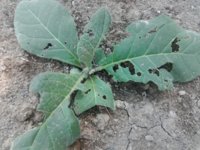
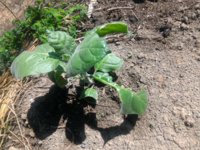
First 2 is examples of growth tip being eaten. And leaf damage on broadleaf and rustica.
Think most of my harvest will be fine if i can slow the damage down.
Currently gonna spray them with neem oil soap spray with ghost pepper juice mixed in. Then diatomacous earth. So whatever wants to eat them can have fun doing so
Cutworms usually lop a small stalk off near ground level. Snails or slugs can destroy the growth tip, as can many other critters. The 3rd image, with the large ragged holes suggests crickets or grasshoppers. The extensive, lopsided leaf defects are from partial damage to a tiny leaf bud, followed by growth of the leaf.
My preference of insecticide is to use imidacloprid (a systemic neonicotinoid) mixed into my transplant water. One dose and done. I use it at the rate recommended for tomatoes. It has no apparent effect on snails or slugs, and only minimal effect on crickets and grasshoppers. Slugs and snails have to be managed with snail bait, like Sluggo. Damage from crickets and grasshoppers can be minimized by eliminating any nearby, tall grass or weeds.
Bob
Just over week 3. Pretty big growth diference between week 2 and 3.


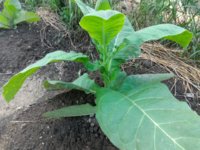
Some things of note. You can see a soil color difference left half vs right half. Left half was tilled and mulched with lawn clippings over years past, so its getting much more growth compared to the fresh tilled side. I think ill add compost around the plants on the right side, might not help allot imediatly but it will get tilled in later and help even it out.
Also the rusticas (pic 2) are doing this every time it rains a bit. They lay down, there not limp its like they pull themself over on purpose everytime it rains at all.
Pic 3 is my biggest so far, a corojo from when i germination tested the newly gotten seeds so its a week or so older and fully on the left fertile side so its growing very fast.
Also i got cover crop seeds. Diakon radish, field peas, wheat and rye. So ill do the plot with those when the crop is out later.
and i dont see any new bug damage, and with rate of growth now i dont think it will be much of an issue any more

What you are seeing is leaf hairs, known as trichomes. They acquire nicotine from the plant roots, then secrete an aqueous (not oily) liquid onto the leaf surface as a natural defense mechanism. So yes, there is nicotine in the trichomes and on the surface of the leaf. It tends to wash away with every rain, and is then promptly replaced. But all the other parts of the plant--stalk, stems, leaf lamina, blossoms--contain nicotine.
Bob
Bob
Bob, do you have a suggested brand for this insecticide. I can only find for trees and shrubs, and house plants. Some say not for edible plants, to me that also means not for smokable plants.Cutworms usually lop a small stalk off near ground level. Snails or slugs can destroy the growth tip, as can many other critters. The 3rd image, with the large ragged holes suggests crickets or grasshoppers. The extensive, lopsided leaf defects are from partial damage to a tiny leaf bud, followed by growth of the leaf.
My preference of insecticide is to use imidacloprid (a systemic neonicotinoid) mixed into my transplant water. One dose and done. I use it at the rate recommended for tomatoes. It has no apparent effect on snails or slugs, and only minimal effect on crickets and grasshoppers. Slugs and snails have to be managed with snail bait, like Sluggo. Damage from crickets and grasshoppers can be minimized by eliminating any nearby, tall grass or weeds.
Bob
This is what I use in my transplant water, at the start of the season. It lasts until close to harvest time.
I apply it at the same rate recommended for tomatoes. I don't use it on fruiting vegetables, since it is still active at the time of fruit blossoming, and will zap pollinators.
Bob
I apply it at the same rate recommended for tomatoes. I don't use it on fruiting vegetables, since it is still active at the time of fruit blossoming, and will zap pollinators.
Bob
Week 4.5
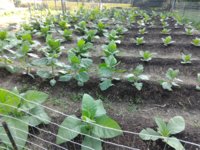
Grew alot but, still issue on the right half not growing much. To try and compensate about a week ago i fully covered the tops of the right half of rows in compost, put 1.5lb 19-19-19 around the small plants. And as standard i been giving each row about 20g actual N watered on each row with a can every 2 weeks. Just did my 3rd aplication i was planning on being the last but i might have to do the small plants once more.
Comparison Photos of havana 1. Left side, 2. Right side, 3. One in the veg garden connected to the left side of the tobacco plot


I guess next year ill have to soil test each side seperately, cause its aparently 2 different kind of soil
Grew alot but, still issue on the right half not growing much. To try and compensate about a week ago i fully covered the tops of the right half of rows in compost, put 1.5lb 19-19-19 around the small plants. And as standard i been giving each row about 20g actual N watered on each row with a can every 2 weeks. Just did my 3rd aplication i was planning on being the last but i might have to do the small plants once more.
Comparison Photos of havana 1. Left side, 2. Right side, 3. One in the veg garden connected to the left side of the tobacco plot
I guess next year ill have to soil test each side seperately, cause its aparently 2 different kind of soil

Week 4.5
View attachment 36918
Grew alot but, still issue on the right half not growing much. To try and compensate about a week ago i fully covered the tops of the right half of rows in compost, put 1.5lb 19-19-19 around the small plants. And as standard i been giving each row about 20g actual N watered on each row with a can every 2 weeks. Just did my 3rd aplication i was planning on being the last but i might have to do the small plants once more.
Comparison Photos of havana 1. Left side, 2. Right side, 3. One in the veg garden connected to the left side of the tobacco plot
View attachment 36919 View attachment 36920 View attachment 36921
I guess next year ill have to soil test each side seperately, cause its aparently 2 different kind of soil
Could the less productive end be receiving less sun?
Is there a difference in shading for the two sides of the garden?
Bob
Bob
ya the right side gets bit less sun. in the big photo the top right corner is where tall pine trees start and extend over to the west (right) so the right half starts getting shade at say 4pm and the left side at 5pm or something like that. but i dont think that can fully explain the sharp transition in size.
you can draw an imaginary line down the plot and plants 1 foot to the right of that line a half as big
you can draw an imaginary line down the plot and plants 1 foot to the right of that line a half as big
How close are the trees? Could the roots intrude into the plot?ya the right side gets bit less sun. in the big photo the top right corner is where tall pine trees start and extend over to the west (right) so the right half starts getting shade at say 4pm and the left side at 5pm or something like that. but i dont think that can fully explain the sharp transition in size.
you can draw an imaginary line down the plot and plants 1 foot to the right of that line a half as big
Shade starting at 4 and 5 pm reduces 14 hours of daylight by 28 to 35% respectively. Shade-grown tobacco is shaded with 40% shade cloth (filters out 40% of the total sunlight). This is modified by reflection of sunlight from any nearby, light colored buildings. Also, as @Knucklehead points out, root intrusion can be an issue. I have noticed the dwarfing effect of root intrusion as much as 20% beyond the radius of a tree's canopy line.
Bob
Bob

Ginsinjones
Well-Known Member
I'm by no means an expert but the top row of plants in my plot are about half the size of the rest. The morning sun hits them about 45 min after the rest of the plants. I do believe that slight difference in first sun has caused this.
Not a big concern as these are the plants the wild turkeys have decided to stomp on and occasionally leave a nice big poo on them.
Not a big concern as these are the plants the wild turkeys have decided to stomp on and occasionally leave a nice big poo on them.
These photos are from my 2018 grow:

24 July

16 August
Bob
24 July
16 August
Bob
tree is maybe 15-20 feet at the closest corner. before tilling i dug a trench on the tree side and axed out a few roots around 2 inch diameter. then the tractor tiller gets pretty deep and didnt hit anything sizable. and i hilled up the dirt to plant in so any tree roots must be over a foot below the plants.
but the closest row and the row 60 feet from any trees dont have any size differnce.
i think its a little bit light, and mostly from how the left was used for growing pumkins and squash ect. so its been tilled and had grass clipping mulch many times. so i think must be rich enough that it made my soil test average out to good numbers. and i only fertilized with nitrogen until recently. so its entirely possible the fresh lawn side is just low in p or k.
guess it would make since over years past the lawn where the right half is now was mowed and dumped on the left as mulch. so basically stealing nutrition from one side and giving it to the other. and also grass from the rest of the yard went on the left too. but a combined soil test would say the whole thing has enough nutrition on average
so im gonna go with different dirt theory for the most part
- Status
- Not open for further replies.
Similar threads

- Replies
- 4
- Views
- 598


- Replies
- 123
- Views
- 24K
-
About Us
This forum is dedicated to promoting the American tobacco farmer and tobacco home growers across the globe. Whether you grow by the acre, in your backyard, or in pots, you should find valuable and accurate information here.We discuss any variety of tobacco, as well as numerous approaches to growing, harvesting, curing, and finishing your crop. Our members will attempt to provide experience-based answers to your questions.
-
Buy raw tobacco from our Sponsor - WLT