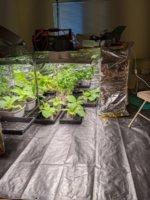
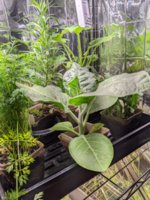
The plants in the first photo look like Virginia Gold does at that stage but they look more like 12 weeks old or more to me. They will easily get to 6-7 feet if planted outside, not counting the flower head. The plant in the second picture is a Rustica. Nicotiana Rustica strains grow quite differently than N. Tobaccum strains do. They all look quite healthy and normal for this stage of their growth.
East side or west side? West you might be able to plant them out in 4 months. East side closer to 5 months. Your profile says you live in Philadelphia PA ??
Color me skeptical. Rustica is a bit more hardy than Tobaccums but they both are tropical or subtropical plants and the plants won't survive Alaskan winters. Not even in the lower panhandle. They might have been able to reseed themselves though. Must of been a hell of a story to pay $14 for a pack of seed. lol
N. Clevelandii and N. Quadrivalvis were cultivated by Native Americans up the west coast from where they originated in the high deserts of the SW. Quadrivalvis was grown as far north as Glacier Bay. The plants die in winter but can reseed themselves. You can still find them both growing wild occasionally in WA, OR and southern BC but I've never heard of either growing in Alaska except when cultivated. And these are entirely different types of nicotianas than common smoking tobaccos. Tiny leaves and horrible to smoke, imho.
Rustica comes from central and south america and was spread up through Mexico by Native Americans by cultivation into the southern US and then up the east coast to Canada. Several different strains emerged. It was never grown in the Pacific NW. The Nicotine content of Rustica strains can range from 6-9%. The lower end is more typical. Burleys average 4-5%. Bright Leafs average 2-3%. A few are lower and a couple stains even go up to 6%. Marylands averages about 2%. Orientals are usually 1-2% with a couple going up to 3%. I have no idea what the nicotine content of the other 80'ish types of nicotiana are.
Welcome to the forum NG.
Great education. Thank you. Like I said this is all brand new to me but I'm perfectly willing to learn.
The first seeds popped on 11/18. I just reviewed my email to someone. I was very excited. No plant is older than 6 weeks in that room.
So you are saying they are doing very very good. At least it seems.
Wall of text and lots of questions to follow. Please put this aside for when you have a moment to actually look at it.
Westside of Washington. At the very edge and the very tip. While I can't see Canada from where I am it's right across the water. So I have a slightly warmer and wetter climate as compared to the rest of the state.
I am perfectly willing to put in half hoop greenhouse to grow a few rows. I have about a 50 foot by 50 foot sunny patch. But only in the summer, right now we are in the "long dark". I'm lucky to get 6 hours of dim light. I see the sun once every 3 days. I have to sit in the grow tent to recharge my sun driven hormones.
I will fix the profile. I misunderstood the reason for the question.
I will order from the local vendor a mix pack of light tobacco in about 2 months to prepare for the outside spring grow.
Is the rustica usable or should I simply throw it out? I don't mind putting it in a one hitter, I don't have to smoke cigarettes.
Is there a pointer to the appropriate nutrient mix?
Is there a pointer to the number of LED watts per square foot that I need to achieve? What are the indications that the plant is getting not enough or too much light?
Does the actual type of light matter? Lots of blue to keep the plant short. Do I need to look for something different for tobacco lights?
Do upward facing young leaves indicating a lack of light or is that simply part of the normal growth pattern and after they get a bit large they will then flatten out?
Is there a bottom and top temperature that I need to be aware of?
Are there any particular airflow requirements? I currently have a reciprocating fan moving back and forth in front of the plants. Is this good for them or is it stressing them?
Is there a range of top temperature? I am heating that room with electricity in a Washington winter and would like to know the minimum temperature that the plant will be happy at.
What is the minimum gallons of dirt I need to achieve a happy plant? They will be in heavy fabric grow bags with an inch of volcanic rock on the bottom sitting in a tray. I was assuming I could get away with three gallons. Was I wrong?
I water until it's soaked and it runs out in the tray. I then might leave a quarter inch of water in the tray. That is at rock level, not dirt level. I'll water again in a couple of days depending on moisture level. I determined moisture level by simply picking up the bag. Light, water, heavy, leave alone. Is this an appropriate watering strategy or should I be doing something else?
Same thing with humidity. What is my min and max? Does it vary at different stages of plant growth?
Do night time temperature swings have a good or bad effect? Right now they're sitting in a room with the thermostat controlled on the wall. No programming of time. And the thermostat calibration sucks and it has a huge swing of range on the off and on. So I get a swing of 65 to 75 for now. I expect to raise it in a bit after they're transplanted to the larger containers and can hold on to more water. Are they happy with a consistent temperature or do they expect night time temperature drops?
What pH does the water need to be? Does it matter? If I am watering outside can I just water from the hose?
My nutrients are currently jack's tomato feed, Epsom salts, and a bit of super thrive. I use half strength as compared to the directions. Is this too much, too little, or should I change anything?
Do they care about chlorine in the water? I have 5 gallon buckets in my shower bubbling at all times for chlorine evaporation before use. I am not growing organic here, I accept that my microbes are always on the edge based on the chemical fertilizers I use. So do I need to pay attention to the bubbling water or can I use it right out of the tap?
Same question on outside watering.
Do I need constant airflow to move the leaves around and strengthen the plant and keep leaf to leaf touching down to minimize fungus possibilities?
Do light hours count beyond the minimum 10? Can I give 18 hours of light to push the tobacco plant or do I need to cut it?
I smoke around a pack a day which according to my research is about half an ounce. The typical plant will produce between five and 8 oz so that means I get about 10 packs of worth of cigarettes per plant. So that means I need at least 20 plants to satisfy my addiction, assuming plant nicotine level matches what I am currently smoking.
Are these assumptions accurate or have been misinformed?
While it would be nice if I could have perennials that survived the winter it's not a requirement. One indoor and one outdoor is the current plan. Two grow passes will easily handle my year, and after that I'll prep indoors and move outdoors for everything. After that for summer I should have enough that they are self-seeding for the next year. How many plants and how close together or far apart should they be to ensure the self-seeding?
Can I do this in a bramble patch? I have some serious thorny viney brambles. Low to the ground. And they produce the most delicious berries. But I was going to clear it out. Do I have to? Can I take a healthy growing 2-month plant and transplant it into the middle of that bramble patch? It will be higher than everything around it. Will the berries from the bramble patch end up with nicotine in them? Their leaves will be touching and absorbing stuff from each other. The rain will fall on the tobacco plant and move nicotine into the ground and all the other plants.
How large an area will I need for appropriate curing and fermenting? Assume 20 plants are harvested to then feed the next steps.
I have an 8x4 tent which I can control temperature and humidity. I will insulate the hell out of it for the fermenting stage. Or I can set up a smaller insulated box. When fermenting it can be done via stacking or hanging, but stacking requires daily work increases the possibility for mold. Does hanging require any ongoing activity?
Thanks for reading this far.