Ancient carving found at Tiahuanaco, Bolivia.
Where did the various species of tobacco come from? Some are wild, others were cultivated and traded over thousands of miles, before the European discovery of America.
Nicotiana rustica, which I had always assumed was wild, is apparently a species intentionally cultivated by particular Indian tribes in southern Mexico, and its seeds were included as an agricultural trade item that reached as far as the Great Lakes. The following material and maps may be useful in considering some of the more obscure accessions in the GRIN database.
This is a quick survey of some of the material found in:
Spinden, Herbert Joseph:
Tobacco is American: the story of tobacco before the coming of the white man.
New York Public Library, 1950.
This book, and many more, can be found in
The Core Historical Literature of Agriculture at
http://chla.library.cornell.edu/c/chla/. (Thanks to FmGrowit for providing this lead.) There are only a half-dozen books there with the word, "tobacco" in the title, but the entire library contains many thousands of books, all readable on-line.
This curious 141 page book was actually published by the New York Public Library, and only 500 copies were ever printed. It was written by an anthropologist who studied the written documentation from hundreds of sources (listed at the end of the book), dating back to 1492, as well as archeologic discoveries from throughout North, Central and South America. Much of the early part of the book is dedicated to the linguistic evidence of tobacco's names and usages. Here is some material from later in the book.
"It should be kept in mind as regards commercial tobacco: the straits of Yucatan and of Florida separate the two domesticated tobaccos of pre-Columbian times so that north and west of this line only
Nicotiana rustica was available, and south and east of it only
Nicotiana tabacum, while the two species mingled in the general region of Panama."
"The old tobaccos of Mexico and the United States were essentially pipe and cigarette tobaccos. The South American species with a larger and broader leaf gave rise to our cigar, or bundle of smaller leaves wrapped in a larger leaf of the same material."
"Perhaps cigars, in our sense, were known and used already to a limited extent by Maya and Aztec smokers when the Spaniards arrived, but cane or cornhusk cigarettes certainly were more usual."
"...in 1528, we must assume that the people of the Valley of Mexico had at least some trading knowledge of the large-leaved
Nicotiana tabacum, which already had penetrated the northern continent as a contribution of recent immigrants from South America."
"It now seems likely that
Nicotiana rustica must have spread south from Mexico as a domesticated plant, certainly over Colombia and Ecuador, possibly as far south as Chile."
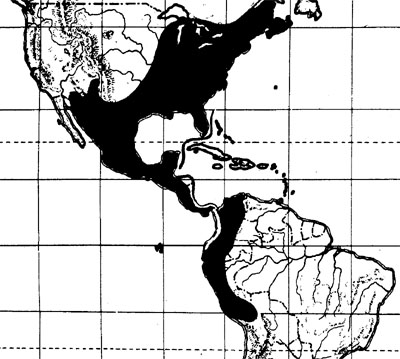
Map of Western Hemisphere showing, in black area, the extent of the spread of
Nicotiana rustica which was aboriginally cultivated in Mexico and Central America. In Virginia, it was soon replaced in English cultivation with
Nicotiana tabacum introduced from the Orinoco [Venezuela].
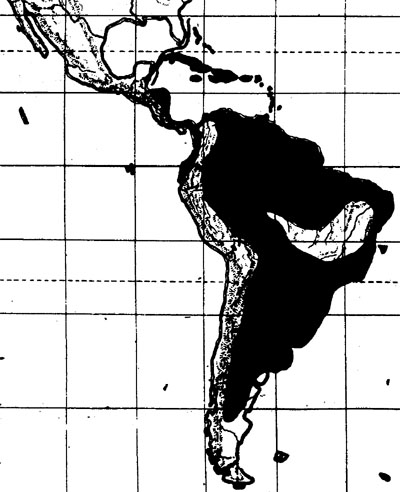
Darkened areas in Central and South America show Indian cultivation of
Nicotiana tabacum. It originated as a hybrid on the eastern slopes of the Andes.
Darkened areas show where wild tobaccos grow; about sixty species appear in the two mountainous areas of America, the heaviest concentration being in Chile and Argentina.
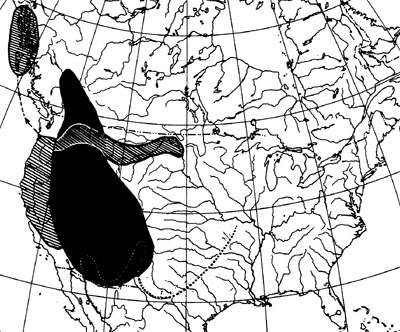
Wild tobaccos in the Northwestern Frontier.
Nicotiana attenuata (black) reaches farthest north of the indigenous tobaccos;
Nicotiana bigelovii (cross-hatching), a wild and semi-domesticated species in California, comes next. Also shown in cross-hatching is
N. quadrivalvis which survives in North Dakota among the Mandan and Hidatsa Indians (the tribe of Buffalo Bird Woman).
Bob