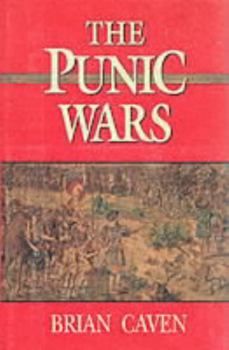
The Punic Wars, by Brian Caven. (1992)
Bob's Background History Lesson (feel free to skip this)
Most of you are probably familiar with the Punic Wars from the story of Hannibal (of the Carthaginians) crossing the Alps with war elephants, to attack Rome. The actual story of the wars stretches out over nearly 120 years. And there were a lot of folks involved who were named "Hannibal".
I'll start by pointing out that the first Punic war began as a low-tension misunderstanding between Rome and Carthage. (Lots of wars begin that way.) It was about trade exclusivity with a small town in Sicily.
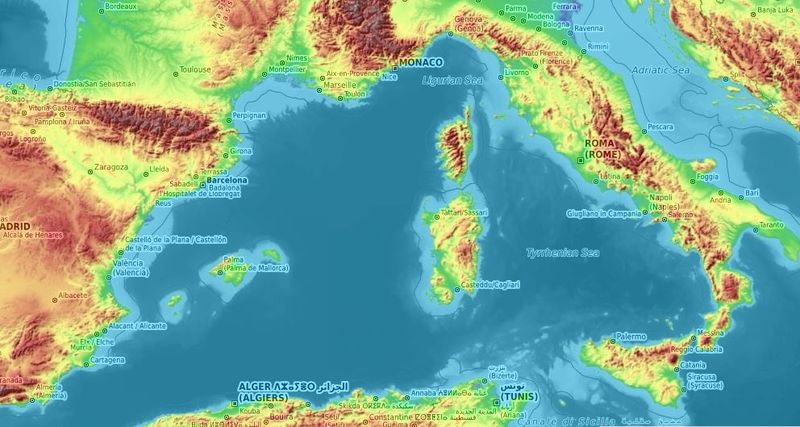
Topography of the western Mediterranean basin.
Who were these people?
Rome, at the start of these wars, was just a city-state of primarily farmers—really combative farmers who liked attacking their immediate neighbors in order to "protect them". [It was an ancient version of a protection racket.] The entire population of Rome was less than 250,000 (including slaves), and their cumulative military skills were modest, though enhanced by their cultural aggressiveness. And those military skills were limited to the land. They had not yet reached the political stage of desiring an empire. Their elected, military leaders were simply wealthy politicians with no military training.
Carthage, in today's Tunisia, was populated by so-called "Punic" people. This word refers to Phoenecians. Who were the Phoenecians? Most scholars today consider them to have been the biblical Canaanites who initially populated the coastal area of today's Lebanon starting around 3000 BC, toward the start of the Bronze Age. And these Canaanites were Semitic, seagoing traders, who incidentally developed one of the earliest known alphabets.
There was an environmental catastrophe [a profound, decadal drought] in all the Mediterranean basin around
1177 BC, which simultaneously collapsed nearly all the ancient civilizations of the Middle East. Egypt hung on by a thread. The ancient Hebrew people departed Egypt at that time. But the Canaanites continued to prosper where they were [in today's Lebanon], since they were able to maintain their sea trade between distant ports during that period.
Eventually, the Canaanites founded colonies (including Carthage) along the northern coast of Africa and as far as today's Morocco, as well as on Sicily, Sardinia and some scattered islands in between. They also traded with the tribes along the southern and eastern coasts of the Iberian peninsula (today's Spain). Their expert seafaring skills enabled them to maintain exclusive trade throughout the western Mediterranean.
The Punic wars began just a few decades after the exploits of Alexander the Great (from Macedon). So the regional empires subsequently formed by Alexander's top Generals (like Seleucus in Judea and Ptolomy in Egypt) were contemporaneous with Carthage.
The Book:
Most of the above is not found in the book. [I had to do some searching to clarify all of it in my mind. History is often taught in disconnected pieces.] Essentially, Rome was a baby state, while the Punic culture, centered in Carthage, was a longstanding, powerful empire of seafaring traders.
Fake news: The often contradictory fragments of the surviving historical record of the Punic Wars were written by individuals (often years after the events) from biased perspectives—either pro-Carthage or pro-Rome. Each perspective attempts to justify the actions of one side or the other. In the absence of actual journalism, the ancients managed nevertheless to create fake news.
From our viewpoint, the details and chronology of what actually happened are still a bit murky. But when the narrative gets to "the" Hannibal of our history books, it picks up specificity and momentum. And the frequent logistical and tactical surprises remind us of the unpredictability of warfare.
"Probably before the middle of May then, [Hannibal] set out from New Carthage [in Spain] with ninety thousand infantry, twelve thousand horse and perhaps forty elephants. He took with him also, in emulation of Alexander the Great, two historians to chronicle his campaign for posterity...."
Within this book, I found the maps sometimes less than helpful. The geographic names often changed within the span of a few decades: Greek, Latin, Punic, etc. To confound the narrative, many of the names of individual people were quite common in that period. So we see different folks in different locations and time periods carrying the very same name. There are also scores of named, peripheral tribes, whose names were only vaguely familiar to me, since I had endured several years of Latin in school, including having to read Caesar's Gallic Wars.
I think that the greatest value of this book is that it tells us about why and how ancient Rome went from a regional bully to the builder of a vast empire.
Bob