Really Easy Perique Press

Status
Not open for further replies.

ArizonaDave

Well-Known Member
Joined
Apr 23, 2014
Messages
2,228
Points
83
Location
Phoenix, AZ (east valley)
Will cigar rolling scraps work for perique? Or does the curing throw it off? SIAP.

I've found a great use for the Cigar scraps, so has Gdaddy. He uses a Criollo 98' Liguero for a wrapper, adds a little Piloto Cubano Seco for balance. Great Cigar! I use a ¼ leaf Aleman Liguero in the blend with Piloto Cubano Seco with a double binder and an Aleman wrap. One of my favorite Cuban Sandwich Cigars yet. I also make snuff and chew out of scraps. I let the leaves dry out to 15% humidity, put them in a blender, pulverize to a powder, then add a rum/vanilla mixture to the dried snuff, then microwave and the alcohol evaporates, but the flavors remain.

Perique is new to me, so I love reading this post.
 

Grumpa

Active Member
Joined
Sep 16, 2014
Messages
39
Points
0
From reading this thread, it seems that Perique is commonly made using color-cured leaf. As I am not able to grow tobacco and being somewhat of an impatient sort, I would like to try with leaf from WLT. Deluxestogie has suggested using Maryland leaf but I was wondering what people thought of using the WLT Threshed/stripped leaf instead. It is a Virginia leaf but it has been discussed that the type of leaf matters little (so it seems) after the processing.

Thoughts?

Grumpa
 

deluxestogie

Administrator
Staff member
Joined
May 25, 2011
Messages
26,133
Points
113
Location
near Blacksburg, VA
I believe the threshed leaf is flue-cured. I have no idea what you might get from a Perique process on that. My suspicion is that it may not work--but it might. It takes 3 months to find out.

Bob
 

deluxestogie

Administrator
Staff member
Joined
May 25, 2011
Messages
26,133
Points
113
Location
near Blacksburg, VA
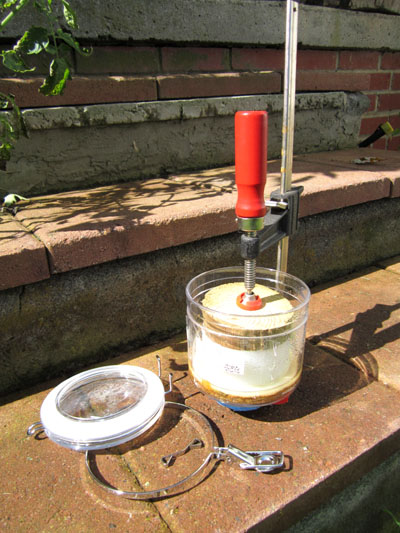
Today, I started a small batch of Perique, using a new (absolutely perfect) Lexan jar, and Sacred Cornplanter rustica that has been hanging since 2012.

Garden20140920_1569_PeriquePress_Cornplanter2012_400.jpg


The jar is similar to the one that begins this thread, is also from Walmart, is half the height, and costs about $6. This time, I took the trouble to remove the lid and its attachments (which can be replaced). For this run, I've cut out a disk of Ensolite foam (from a cheap backpacker's sleeping pad) to fit within the rim on the outside bottom of the jar--just to distribute the clamp pressure a bit better.

The Cornplanter varied in color from dull tan to dull gray-green. The leaf is fairly tattered. It still smells grassy and unappetizing. I stemmed it, thoroughly misted it, and packed it into the jar using the polypropylene follower from one of my cheese press molds (same as the first run). A much thinner slice of wood fence post is used to distribute the force of the clamp onto the upper rim of the follower.

The leaf for this batch (maybe 20-25 leaves) initially hand-packed to the rim of the jar, then compressed to the wafer you now see at the bottom of the jar. A slight amount of water stands above the tobacco. It was the entirety of my remaining Sacred Cornplanter.

Why is this a perfect jar? Since it is not glass, there is no worry about shards, should it shatter. That was also true of the taller jar. Its center of gravity is lower, so it is less likely to tip over should the press be accidentally bumped. Its smaller size discourages making too large a batch. I still have some of my very first batch in my refrigerator. This smaller jar can clearly hold 10 times as much leaf as I've put into it, if compressed in stages. As with the taller jar, Perique simply does not adhere to the surface, so it can be removed easily. And lastly, it is still the perfect inside diameter for my polypropylene follower. Since the jar is much shorter than my original jar, I should be able to store it in the fridge still in the jar.

Other than removing all the leaf, and spreading it to air once or twice during the three month process, it's pretty much a set and forget project.

How much pressure am I applying? I have no idea. When the handle can be turned a little more, I tighten it to a degree similar to tightening a jar of food--very snug, but not extreme.

Bob

 

deluxestogie

Administrator
Staff member
Joined
May 25, 2011
Messages
26,133
Points
113
Location
near Blacksburg, VA
Sacred Cornplanter Perique

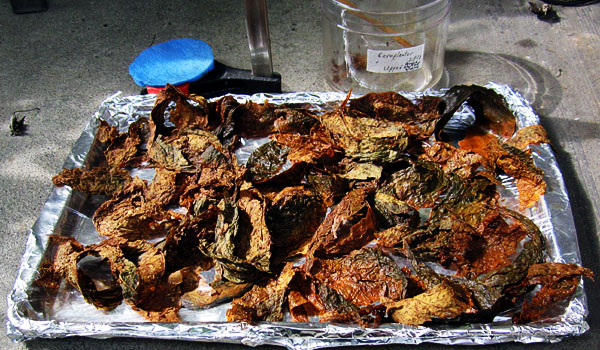
It's been about 3 weeks since I packed my remaining 2012 Sacred Cornplanter (Nicotiana rustica) upper leaf into my Perique press. The aroma is an unpleassant, chemical smell, resembling shellac maybe. There is no fecal aroma. No fruity aroma.

Garden20141013_1603_CornplanterPerique_600.jpg


I really didn't want to touch it, so I used a bamboo chopstick to tease out the leaves. I placed them onto a tray that has plastic wrap covering it. The color at this point is the best this Cornplanter has ever known. You can still see some of the gray-green, but most of the leaves are a nice reddish brown. I expect (insist!) that it will darken further, after this exposure to the clean, country air of southwest Virginia.

Garden20141013_1602_CornplanterPerique_closeup_600.jpg


Once it dries a bit, the leaves will have more tensile strength, and I will be able to separate and unfold them better, before misting them and returning them to the press for an uninterruped run, until just before Christmas.

Bob
 

oldbear

Well-Known Member
Joined
Feb 19, 2014
Messages
50
Points
8
Deluxstogie,
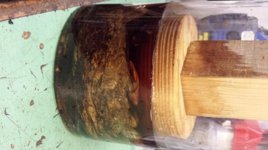
The point of "perique processing" is to pack slightly moist tobacco in an airtight environment for it to ferment anaerobically for up to three months , then periodically airing it out and repacking it. From your photo it appears you might not have had an anaerobic environment. If air can get to your tobacco you only get rotten tobacco. Try using 4" PVC pipe, perhaps with a bottom cap and a fairly tight fitting wood plug. The advantage of this is that you can open both sides of the pipe and push it out to repack it.
Oldbear
 

Knucklehead

Moderator
Founding Member
Joined
Oct 18, 2012
Messages
12,777
Points
113
Location
NE Alabama
Deluxstogie,
The point of "perique processing" is to pack slightly moist tobacco in an airtight environment for it to ferment anaerobically for up to three months , then periodically airing it out and repacking it. From your photo it appears you might not have had an anaerobic environment. If air can get to your tobacco you only get rotten tobacco. Try using 4" PVC pipe, perhaps with a bottom cap and a fairly tight fitting wood plug. The advantage of this is that you can open both sides of the pipe and push it out to repack it.
Oldbear

The moisture squeezing out from around the lid assures an airtight environment.
 

deluxestogie

Administrator
Staff member
Joined
May 25, 2011
Messages
26,133
Points
113
Location
near Blacksburg, VA
Deluxstogie,
The point of "perique processing" is to pack slightly moist tobacco in an airtight environment for it to ferment anaerobically for up to three months , then periodically airing it out and repacking it. From your photo it appears you might not have had an anaerobic environment. If air can get to your tobacco you only get rotten tobacco. Try using 4" PVC pipe, perhaps with a bottom cap and a fairly tight fitting wood plug. The advantage of this is that you can open both sides of the pipe and push it out to repack it.
Oldbear
The method discussed in this thread works perfectly. Nothing rotten here. My final product, along with those of several other members, were sent out for blind tasting, for comparison among them, as well as for comparison with a sample of St. James parish Perique. Each was excellent. Each was slightly different. Most tasters could not identify which was the St. James parish Perique.

The liquid seal, as Knucks points out, is key.

Bob
 

jojjas

Well-Known Member
Joined
Jan 1, 2013
Messages
387
Points
43
Location
Skövde , Sweden
Thanks to Bob who inspired me , i had to try this of my own and so far it has gone as planned
20141008_213838.jpg
Started this 7 weeks ago leafs from perique seeds that Chillardbee sent me , and it started to get bubbles immediately ,
air out after 2 weeks first time , and this evening was second air out , the scent was real good , fresh and fruity , maybe a little tiny scent of manure is still there , and maybe an silage aroma can be detected but nothing that bothers me
20141108_182306.jpg
Sorry for the bad photo
Colour is not so dark as i thought it should be , but maybe it will darken with time in the jar
 

Grumpa

Active Member
Joined
Sep 16, 2014
Messages
39
Points
0
I believe the threshed leaf is flue-cured. I have no idea what you might get from a Perique process on that. My suspicion is that it may not work--but it might. It takes 3 months to find out.

Bob
Well, I am about 2 weeks into finding out. Using the patented deluxestogie process, I am presently Periqueing 3 different tobaccos: Maryland, TN90 and Flue Cured Threshed/Stripped. I plan on airing out the leaf every week for the first month then every two weeks until completion. Why? Because I want to do it that way.

After the the first airing, the FC had a wonderful haylage smell to it. The burley had a very slight ammonia smell that dissipated rapidly and then just a wet leaf smell. The Maryland smelled just like the burley after the NH3 dissipated. No bad smells at all. At the second airing, the FC had lost some of the hay aroma and developed a more earthy smell. Still smelled quite good. Both the Maryland and the TN90 had a stronger more earthy smell too. Again no bad smells at all.

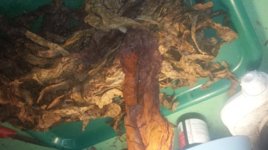
The picture below was taken a few days after the first airing. The high liquid level is an artifact due to the plastic being pulled reasonably tightly to the side of the jar.

IMG_0099.jpg
 

deluxestogie

Administrator
Staff member
Joined
May 25, 2011
Messages
26,133
Points
113
Location
near Blacksburg, VA
No bad smells at all.
Uh oh!

Great comparison batches. I'm eager to see how they turn out--especially the flue-cured leaf. Maybe even collards will make Perique. I appreciate your clarification about the apparently high liquid level. Looks like all is good. With all the airing, your results should end up about as black as it's possible to make Perique.

Bob
 

ArizonaDave

Well-Known Member
Joined
Apr 23, 2014
Messages
2,228
Points
83
Location
Phoenix, AZ (east valley)
Uh oh!

Great comparison batches. I'm eager to see how they turn out--especially the flue-cured leaf. Maybe even collards will make Perique. I appreciate your clarification about the apparently high liquid level. Looks like all is good. With all the airing, your results should end up about as black as it's possible to make Perique.

Bob
Have you made Perique from actual Perique leaf? I find it so interesting that your applying this process to different leaves, which is a great idea! Plus I enjoy reading your various posts!
 

deluxestogie

Administrator
Staff member
Joined
May 25, 2011
Messages
26,133
Points
113
Location
near Blacksburg, VA
Although I have grown Perique in the past, I have not pressure-cured it. From the half-dozen or so varieties of tobacco that I've tasted made into Perique, in addition to a long familiarity with St. James Parish Perique, I can say that the differences seem to be in the inherent nicotine content of the leaf variety, and subtle differences in the floral nature of the final product. Jitterbugdude's multi-member Perique comparison trial last year demonstrated that all are similar, and each is somewhat unique. But the overarching similarity predominates.

Bob
 

ArizonaDave

Well-Known Member
Joined
Apr 23, 2014
Messages
2,228
Points
83
Location
Phoenix, AZ (east valley)
Although I have grown Perique in the past, I have not pressure-cured it. From the half-dozen or so varieties of tobacco that I've tasted made into Perique, in addition to a long familiarity with St. James Parish Perique, I can say that the differences seem to be in the inherent nicotine content of the leaf variety, and subtle differences in the floral nature of the final product. Jitterbugdude's multi-member Perique comparison trial last year demonstrated that all are similar, and each is somewhat unique. But the overarching similarity predominates.

Bob

Very interesting! I will also look up his thread. On a side topic, what do you think is the best floral natured tobacco plant you've ever grown?

I believe this is the thread you were referring to? http://fairtradetobacco.com/threads/4178-Perique-the-plot-thickens?highlight=Perique
 

DGBAMA

Well-Known Member
Joined
Feb 10, 2013
Messages
4,418
Points
63
Location
NORTH ALABAMA
What is the best temp for the process? And if temp is too low, will it simply take longer?
 

deluxestogie

Administrator
Staff member
Joined
May 25, 2011
Messages
26,133
Points
113
Location
near Blacksburg, VA
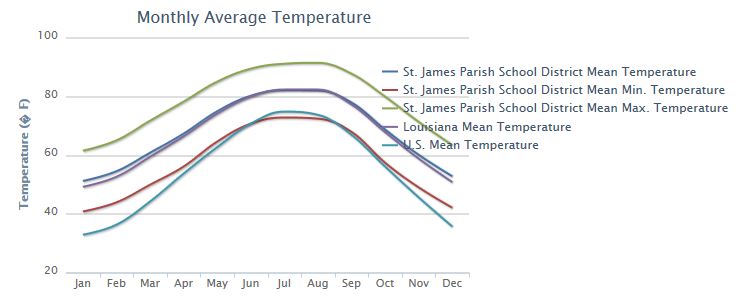
I really don't know the best temp. I try to avoid very high temp, and prevent it from freezing. During warmer months, I keep it outdoors, in the shade. During winter months, it's on my enclosed back porch, which generally stays above 60ºF. Since the entire process is enzymatic (albeit partially microbiological), I would assume that the process slows at low temps.

In St. James Parish, LA, it appears to be processed in an open barn. You can Google the average temp chart for that area--but it's seldom really hot, and doesn't freeze.

Bob

StJamesParish_avgTemps.JPG
 

Jitterbugdude

Moderator
Founding Member
Joined
May 22, 2011
Messages
4,266
Points
113
Location
Northeast Maryland
I've processed mine in the garage with temps in the 90's and I've processed some in my basement with temps in the 70's. Doesn't seem to make a difference. I know that when making sour dough bread there are different yeast to bacteria ratios that exist depending on the temperature. This is probably true for Perique too but probably too subtle for anyone to notice.
 
Status
Not open for further replies.
Top