
A kiln is used after leaf is properly color-cured.
Bob
Bob


My bad. Thanks Bob for clarifying my post. I know what I meant, so assumed everyone else would.It is true that an insulated container can serve many purposes. Kilning (the process) is used for fermentation. Flue-curing (the process) is used for rapid yellowing and fixation of flue-cure varieties. Color-curing (the process) involves maintaining suitable conditions for a leaf to remain alive long enough to complete the natural senescence and death processes. The essential differences among these three processes are temperature, humidity and the stability of those.
This comes down to a wealth of processes that a single container (or entire building) can allow. The confusion is in what exactly one is recommending, in response to a grower's question. I'm sure I make ambiguous recommendations all too often. My aspiration is to differentiate the use of a chamber for color-curing from the use of a chamber for kilning (fermentation) or flue-curing.
Tobacco nomenclature is about as messy as that of any centuries-old industry.
Bob

I did not create the graph. (I don't even own a wet-bulb thermometer, since it is a relic of the 19th century, before you could easily measure humidity with a simple hygrometer.) That is an industry standard graph for flue-curing, but not for color-curing or fermentation. The time scale and temperatures are ideal for starting with green leaf of either flue-cured varieties or most Orientals.I don't know if he made it.

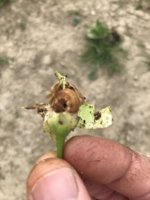
Thank you both for the information. I certainly plan on building one but as it is so late in the season now I figured I would make it an indoor winter project and really take my time with it. In other news I found my first tobacco budworm EVER today. It came from my burley plant which is also INFESTED with aphids under the bud bag. I sprayed with permethrin before I bagged but I guess not enough.I did not create the graph. (I don't even own a wet-bulb thermometer, since it is a relic of the 19th century, before you could easily measure humidity with a simple hygrometer.) That is an industry standard graph for flue-curing, but not for color-curing or fermentation. The time scale and temperatures are ideal for starting with green leaf of either flue-cured varieties or most Orientals.
I agree that building a kiln/flue-curing chamber is a wise investment of time (about a weekend) and money (around $100 to $150), for most home growers, regardless of their ambient climate. A curing chamber, which can certainly be the very same container--so long as it can be adequately vented of moisture--may be useful in uncooperative climates--too dry or too wet. "Traditional" tobacco growing regions are typically those with climates that allow color-curing in a simple shed or barn.
Bob
Regarding the whole using a kiln for color curing etc…I understand what you meant. Semantics…kind of. If you use a “kiln” to color cure (successfully) than it is a curing chamber during that period of time. But then how will you kiln your cured leaf in a curing chamber?..haha…sorry I’m just having some fun. Thanks to both of you for the help!!Bob
A kiln can be used for yellowing. I've done it many times. You put out a graph on the temperature and times ect. A part of one of your posts. Post #12 Aug 2013
DGBAMA Redneck Curing Chamber Build
To preface, my intent this year as a first time grower was simply to have smokable at minimal cost. Grow, hang, dry, smoke..............Weather in the S.E. has been something of a "B#$%^" this year. Our August weather should be great for air curing......mid-upper 90s w/ good...fairtradetobacco.com
If you plan to use it to color-cure, then you will definitely need a vent and air flow, since 80% of the weight of leaf you put in will come off as water. For color-curing, keep the temp below 104ºF until the leaf is yellowed.
Oldfella
Yes, that would clarify things GREATLY!!…HAHAFor clarity, we could name the different processes available within the same chamber (hereafter to be known as a Curvid-21) with Greek letters: Alpha variant, Beta variant, Gamma variant, and the dreaded Delta variant. And...if you immunize your tobacco with the BT vaccine, you can prevent bud worms (85% effective for older plants).
Bob
CURVID-21, Hmmmm, sounds interesting.For clarity, we could name the different processes available within the same chamber (hereafter to be known as a Curvid-21) with Greek letters: Alpha variant, Beta variant, Gamma variant, and the dreaded Delta va5riant. And...if you immunize your tobacco with the BT vaccine, you can prevent bud worms (85% effective for older plants).
Bob

I’ve used a seedling propagation heat mat. Stack the leaves on the mat and shuffle them as needed until all dry.Does anyone have any techniques for accelerating the drying of the mid rib of air curing/sun curing tobacco leaves. The lamina seems fully cured but just seems to remain in low case FOREVER along with the mid rib. I don’t consider curing done until the mid rib is completely dry though. I remember reading someone saying they used some kind of heating mat? Like a heating pad? Does anyone think a hair dryer would work? I’m just getting impatient because I need the room to cure more tobacco…HA! Any help would be greatly appreciated.
The aroma has not been affected…yet. That’s why I was surprised to see mold at bottom of jar through the glass.Aflatoxin is destroyed by burning the tobacco. So it would not be safe as smokeless or as a cigar wrapper. Otherwise, the aroma is the only issue.
Bob
The aroma has not been affected…yet. That’s why I was surprised to see mold at bottom of jar through the glassAflatoxin is destroyed by burning the tobacco. So it would not be safe as smokeless or as a cigar wrapper. Otherwise, the aroma is the only issue.
Bob
Out of curiosity, have you ever encountered mold and continued to use the affected tobacco? I know technically what you said is correct I’m just looking for some personal experiences with it.Aflatoxin is destroyed by burning the tobacco. So it would not be safe as smokeless or as a cigar wrapper. Otherwise, the aroma is the only issue.
Bob
Of course. And so have you. And so has every other tobacco user. Mold is not only ubiquitous, it can be analytically detected in damn near every tobacco product and tobacco commodity everywhere. It is often dismissed in tobacconists' humidors with the mythology of "plume".have you ever encountered mold and continued to use the affected tobacco?
As with the food you eat, eliminate the obvious mold.This investigation documents that tobacco companies have identified and quantified bacteria, fungi, and microbial toxins at harvest, throughout fermentation, and during storage.
Cigarette Smoke, Bacteria, Mold, Microbial Toxins, and Chronic Lung Inflammation
Chronic inflammation associated with cigarette smoke fosters malignant transformation and tumor cell proliferation and promotes certain nonneoplastic pulmonary diseases. The question arises as to whether chronic inflammation and/or colonization of the airway can be attributed, at least in part...www.hindawi.com

We discuss any variety of tobacco, as well as numerous approaches to growing, harvesting, curing, and finishing your crop. Our members will attempt to provide experience-based answers to your questions.