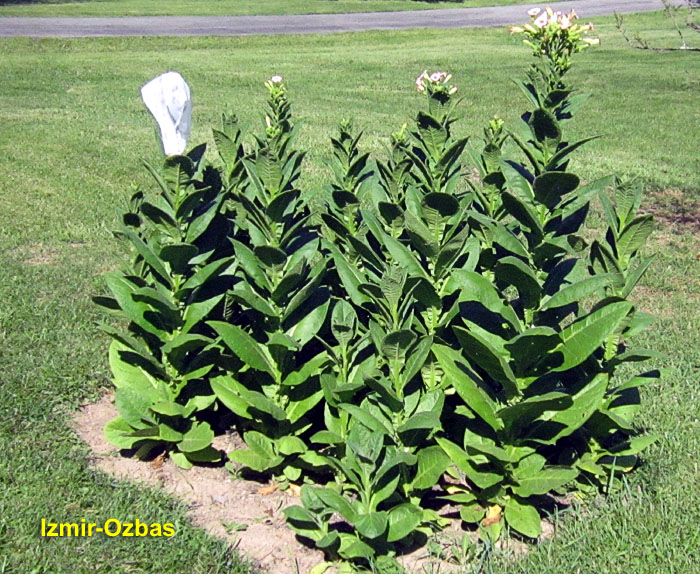

Yesterday, no hornworm eggs. Today, I spotted the first hornworm eggs of the season.
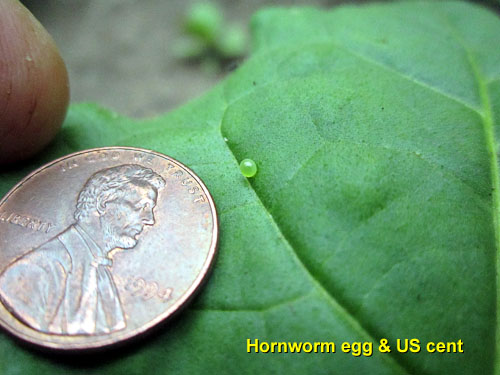
This is an image from 12 years ago. The egg is the size of Lincoln's chin.
Hornworm eggs are usually laid at night (by a hawk moth). They appear as a solitary, bright green, iridescent sphere. You can lift it off the leaf with your fingers, and pop it with a thumbnail. Typically, I see only one or two separate hornworm eggs on the upper surface of a leaf. Inspecting the underside usually reveals a couple more. The eggs tend to be laid on several leaves of each plant, within a group of neighboring plants.
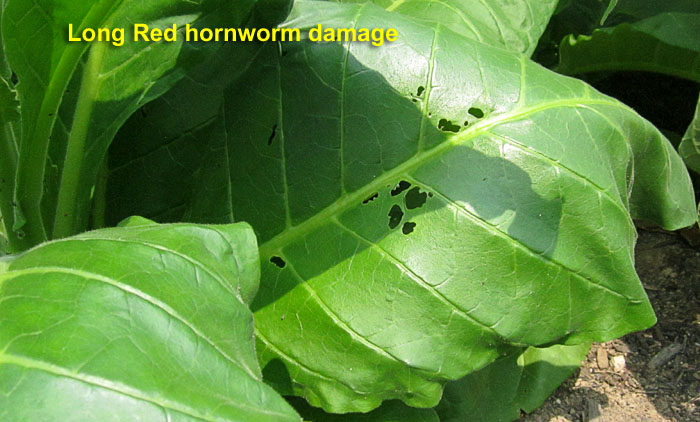
It's worth noting that, once laid, a hornworm egg requires about 96 hours to hatch into a tiny hornworm. At that point, the hornworm eats a pinhole through the leaf. So a new pinhole warrants inspection of the underside of that leaf.
In the past, I have carefully inspected each leaf of each plant at least once a day, and then picked and popped any hornworms. This is quite tiring, since it requires stooping at each plant. For a number of years now, I use my discovery of the first hornworm eggs to begin weekly spraying with BT (Bacillus thuringiensis). Although BT is available at many garden shops in a pre-mixed spray bottle, buying BT concentrate is far less expensive. The concentrate that I purchase is mixed at a ratio of 1 tsp (5 ml) BT to 1 quart (or liter) of water. Having initially purchase a 1 quart spray bottle of BT in the past, I simply refill it as needed, using the concentrate/water mixture. A quart of spray will last me from one to four sprayings (depending on the size of my grow). I always wash my hands after handling BT.
Starting this evening, I will begin spraying BT on the tobacco weekly, for the remainder of the growing season. I try to pick a moment in the evening when there is little wind, and the tobacco leaves have begun to reach upwards in the dimming sunlight. I stand upwind of the plants I'm spraying, and make an effort to spray each plant (~3 spray squirts) from at least two different directions. I am not thorough with this.
Since a hornworm egg must hatch, and then the baby hornworm must take a bite of the leaf lamina to ingest the BT, the result of weekly spraying is that I end up with some leaves with pinholes. That's good enough for me, since the alternative is an order of magnitude more labor.
Bob
EDIT: BT is considered to be an "organic" pesticide.
This is an image from 12 years ago. The egg is the size of Lincoln's chin.
Hornworm eggs are usually laid at night (by a hawk moth). They appear as a solitary, bright green, iridescent sphere. You can lift it off the leaf with your fingers, and pop it with a thumbnail. Typically, I see only one or two separate hornworm eggs on the upper surface of a leaf. Inspecting the underside usually reveals a couple more. The eggs tend to be laid on several leaves of each plant, within a group of neighboring plants.
It's worth noting that, once laid, a hornworm egg requires about 96 hours to hatch into a tiny hornworm. At that point, the hornworm eats a pinhole through the leaf. So a new pinhole warrants inspection of the underside of that leaf.
In the past, I have carefully inspected each leaf of each plant at least once a day, and then picked and popped any hornworms. This is quite tiring, since it requires stooping at each plant. For a number of years now, I use my discovery of the first hornworm eggs to begin weekly spraying with BT (Bacillus thuringiensis). Although BT is available at many garden shops in a pre-mixed spray bottle, buying BT concentrate is far less expensive. The concentrate that I purchase is mixed at a ratio of 1 tsp (5 ml) BT to 1 quart (or liter) of water. Having initially purchase a 1 quart spray bottle of BT in the past, I simply refill it as needed, using the concentrate/water mixture. A quart of spray will last me from one to four sprayings (depending on the size of my grow). I always wash my hands after handling BT.
Starting this evening, I will begin spraying BT on the tobacco weekly, for the remainder of the growing season. I try to pick a moment in the evening when there is little wind, and the tobacco leaves have begun to reach upwards in the dimming sunlight. I stand upwind of the plants I'm spraying, and make an effort to spray each plant (~3 spray squirts) from at least two different directions. I am not thorough with this.
Since a hornworm egg must hatch, and then the baby hornworm must take a bite of the leaf lamina to ingest the BT, the result of weekly spraying is that I end up with some leaves with pinholes. That's good enough for me, since the alternative is an order of magnitude more labor.
Bob
EDIT: BT is considered to be an "organic" pesticide.
Last edited: