Is Rustica an Annual or Perennial?

NewTobaccoGrower

Well-Known Member
Joined
Jan 31, 2024
Messages
99
Points
33
Location
Florida & West Virginia
Has anyone raised and kept a Rustica of any variety for longer than a year? Sites describe Rustica as "an annual, but also a short-lived perennial", which makes no sense. Which is it? And why is it "short-lived"? It's doubtful that it just spontaneously dies after 1 year or 2 years have passed. Is it "short-lived" because hardly anyone cares for them beyond a year, i.e. they don't overwinter them?

For that matter, what is the longest anyone has kept any species or variety of tobacco on this site?

Thanks.
 

deluxestogie

Administrator
Staff member
Joined
May 25, 2011
Messages
26,108
Points
113
Location
near Blacksburg, VA
Most species of the genus, Nicotiana, are perennial plants. But they are not very cold-hardy. So in temperate climates, Nicotiana is replanted as an annual, even though new suckers may sprout from roots, following a mild winter. The leaf quality of the first year of leaves is sometimes superior to those of subsequent years.

Bob
 

crasch

Active Member
Joined
Aug 14, 2023
Messages
28
Points
28
Location
Montgomery County, Texas
Has anyone raised and kept a Rustica of any variety for longer than a year? Sites describe Rustica as "an annual, but also a short-lived perennial", which makes no sense. Which is it? And why is it "short-lived"? It's doubtful that it just spontaneously dies after 1 year or 2 years have passed. Is it "short-lived" because hardly anyone cares for them beyond a year, i.e. they don't overwinter them?

For that matter, what is the longest anyone has kept any species or variety of tobacco on this site?

Thanks.
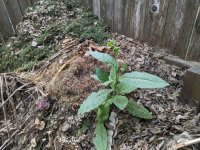
This guy is growing on my compost pile right now, getting ready to flower. It's a sucker from the discarded rootball of a plant I stalk-cut this fall, buried beneath all kinds of junk. I don't know the formal definition of what exactly makes a plant perennial, but it seems to me that it's definitely trying hard to hang on as long as possible.

PXL_20240311_175025127 Large.jpeg
 

deluxestogie

Administrator
Staff member
Joined
May 25, 2011
Messages
26,108
Points
113
Location
near Blacksburg, VA
what exactly makes a plant perennial
  • annual: a plant which naturally germinates, flowers, and dies in one year
  • biennial: a plant that requires two years to complete its life cycle
  • perennial: a plant that is active throughout the year or survives for more than two growing seasons
  • monocarpic: a plant that flowers and bears fruit only once before dying
  • polycarpic: bearing fruit repeatedly, or year after year

Bob
 

NewTobaccoGrower

Well-Known Member
Joined
Jan 31, 2024
Messages
99
Points
33
Location
Florida & West Virginia
Most species of the genus, Nicotiana, are perennial plants. But they are not very cold-hardy. So in temperate climates, Nicotiana is replanted as an annual, even though new suckers may sprout from roots, following a mild winter. The leaf quality of the first year of leaves is sometimes superior to those of subsequent years.

Bob
So they are naturally perennials, and 'artificially' annuals, due to usual agricultural practices. Thank you for the explanation. As a hobbyist who is doing it more for the experience than for the biomass, I'd hate to put a lot of effort into raising a plant just to watch it inevitably die at the end of the season. I'm going to try to keep some of the plants smaller (and in pots) and attempt to keep them alive for as many years as I can. Will of course have to bring them indoors in the winter (in WV anyway) and keep them under lights of some kind. The next question will be what sorts of lights would be necessary to just keep an adult plant alive indoors for 5 months or so out of the year. Am sure they are not like houseplants which can survive on ambient light.
 

NewTobaccoGrower

Well-Known Member
Joined
Jan 31, 2024
Messages
99
Points
33
Location
Florida & West Virginia
This guy is growing on my compost pile right now, getting ready to flower. It's a sucker from the discarded rootball of a plant I stalk-cut this fall, buried beneath all kinds of junk. I don't know the formal definition of what exactly makes a plant perennial, but it seems to me that it's definitely trying hard to hang on as long as possible.
Wow, so it survived the winter out there? They are quite the survivors!
 

ChinaVoodoo

Moderator
Joined
Sep 1, 2014
Messages
7,220
Points
113
Location
Edmonton, AB, CA
So they are naturally perennials, and 'artificially' annuals, due to usual agricultural practices. Thank you for the explanation. As a hobbyist who is doing it more for the experience than for the biomass, I'd hate to put a lot of effort into raising a plant just to watch it inevitably die at the end of the season. I'm going to try to keep some of the plants smaller (and in pots) and attempt to keep them alive for as many years as I can. Will of course have to bring them indoors in the winter (in WV anyway) and keep them under lights of some kind. The next question will be what sorts of lights would be necessary to just keep an adult plant alive indoors for 5 months or so out of the year. Am sure they are not like houseplants which can survive on ambient light.
If I let N. rustica, N. tabacum, and N. alata go to seed, they will return the next year with new plants from seed. Rustica can mature to the point of producing new seed. It gets to –40° here.
 

ChinaVoodoo

Moderator
Joined
Sep 1, 2014
Messages
7,220
Points
113
Location
Edmonton, AB, CA
I think if I lived in the South, I would just leave it on the back step and bring it in and put it in a window if it dropped below 50°
 

NewTobaccoGrower

Well-Known Member
Joined
Jan 31, 2024
Messages
99
Points
33
Location
Florida & West Virginia
If I let N. rustica, N. tabacum, and N. alata go to seed, they will return the next year with new plants from seed. Rustica can mature to the point of producing new seed. It gets to –40° here.
Wow, awesome that the plants can reseed under those frigid conditions. But those are not the original adult plants. I imagine that in South America or Mexico, the original plants live for years and years. Maybe I'm wrong.
 

NewTobaccoGrower

Well-Known Member
Joined
Jan 31, 2024
Messages
99
Points
33
Location
Florida & West Virginia
I think if I lived in the South, I would just leave it on the back step and bring it in and put it in a window if it dropped below 50°
Yep I agree. Unfortunately my area half the year would be WV, where it gets very frigid, usually lots of snow, and very little sunlight after the Fall. Florida is of course not a problem, but my plants would have to travel with me to wherever I happen to be.
 

deluxestogie

Administrator
Staff member
Joined
May 25, 2011
Messages
26,108
Points
113
Location
near Blacksburg, VA
I imagine that in South America or Mexico, the original plants live for years and years. Maybe I'm wrong.
Commercially grown tobacco in the Caribbean, Mexico and Brazil (near the equator) are planted from seed each year. In addition to better leaf quality, removing this year's stalks and roots from the field dramatically reduces overwintering tobacco pests of all sorts, and minimizes problems with next year's crop.

As for "the South", the Florida panhandle regularly freezes in winter, and the upper portion of the Florida peninsula gets a hard freeze every few years.

Bob
 

NewTobaccoGrower

Well-Known Member
Joined
Jan 31, 2024
Messages
99
Points
33
Location
Florida & West Virginia
Commercially grown tobacco in the Caribbean, Mexico and Brazil (near the equator) are planted from seed each year. In addition to better leaf quality, removing this year's stalks and roots from the field dramatically reduces overwintering tobacco pests of all sorts, and minimizes problems with next year's crop.

As for "the South", the Florida panhandle regularly freezes in winter, and the upper portion of the Florida peninsula gets a hard freeze every few years.

Bob
I don't mean commercially grown, I mean where they grow endemically. For example palm trees are "grown" as adornments, but they also just grow wild in Florida. I imagine the same is true of tobacco in Latin America. They grow wild, I would imagine. Otherwise, how would they have been discovered in the first place?
And yes I know about the panhandle, but I'm in Lake County, waaay below the panhandle. It's regularly about 10 degrees hotter than even Daytona. I drive between the two regularly and it amazes me how much hotter and more humid it is here, only an hour's drive away. Probably because we're right next to many, many lakes and there is far less breeze.
 

deluxestogie

Administrator
Staff member
Joined
May 25, 2011
Messages
26,108
Points
113
Location
near Blacksburg, VA
where they grow endemically
For N. tabacum, that would be on the eastern slopes of the Andes, and for N. rustica, the mountains of Central America and Mexico. However, both of those species of tobacco have been agronomically managed (with active human grower selection) for at least a couple of thousand years. When the USDA sent "Agricultural Explorers" all over Mexico, Central America and South America (as well as to other continents), during the 1920s and 1930s, nearly every meaningful variety of tobacco that they discovered (much of which you see in the USDA ARS-GRIN germplasm bank) was being intentionally cultivated as annuals, often by isolated families, alongside their homes.

If you want some generic pipe or cigarette tobacco—just something with nicotine, and that will burn, then give multi-year growing a try, and report your results. If you are hoping instead for cigar wrapper or specific varietal characteristics, I suspect that you will be disappointed.

Bob
 

NewTobaccoGrower

Well-Known Member
Joined
Jan 31, 2024
Messages
99
Points
33
Location
Florida & West Virginia
For N. tabacum, that would be on the eastern slopes of the Andes, and for N. rustica, the mountains of Central America and Mexico. However, both of those species of tobacco have been agronomically managed (with active human grower selection) for at least a couple of thousand years. When the USDA sent "Agricultural Explorers" all over Mexico, Central America and South America (as well as to other continents), during the 1920s and 1930s, nearly every meaningful variety of tobacco that they discovered (much of which you see in the USDA ARS-GRIN germplasm bank) was being intentionally cultivated as annuals, often by isolated families, alongside their homes.

If you want some generic pipe or cigarette tobacco—just something with nicotine, and that will burn, then give multi-year growing a try, and report your results. If you are hoping instead for cigar wrapper or specific varietal characteristics, I suspect that you will be disappointed.

Bob
Thank you for that explanation, this site is always a source of great information, I learn new things all the time here. Didn't know about the worldwide explorations. I guess if searches of 100 years ago yielded nothing but 'domesticated' species and varieties, then such a search is about as quixotic as searching for an intermediate species between wolf and domestic dog today-- if there ever was one, it's long disappeared. Since you seem very knowledgeable on the subject, I wonder if you know if the genomes of any tobacco species or varieties have been mapped? Have any prehistoric remnants or seeds of tobacco been found (perhaps on mummified clothing, etc), and if so, have these been mapped too? And if so, have they been compared?

I perhaps should have explained myself better-- I would be keeping some of the plants alive indefinitely/perennially not to harvest the leaves but just as conversation pieces (kept small in pots, and probably mostly indoors), especially if they have attractive flowers. The ones I harvest from I'd get rid of at the end of the season. I figure it would be enough of a challenge and enough to worry about to just keep them alive, without also taking their leaves. Of the species and varieties, probably the Rustica would be the smallest and most suitable, maybe the Yellow Orinoco. And the least suitable would be something like the Virginia Brightleaf, mine already being relatively enormous at 35 days.

The harvesting of leaves etc is going to be a whole other and completely different challenge. I've never smoked anything in my life, and I'm completely asnosmic (meaning I've never been able to smell anything) so I'll be depending on family members to let me know what different leaves smell like. Actually I'm curious now about smoking cigars, and how I would experience it-- it will likely be all about the taste and am curious if the taste of different tobaccos corresponds with how they smell.
 

deluxestogie

Administrator
Staff member
Joined
May 25, 2011
Messages
26,108
Points
113
Location
near Blacksburg, VA
Nicotiana tabacum is an allotetraploid, derived from a chance crossing of two other (diploid, non-tabacum) species of Nicotiana: N. tomentosa and N. sylvestris. It's all been sort of mapped. There are many duplicated sequences scattered about. [Hey, Arabidopsis, can you spare a dime?] I would invite you to have a look at the links under Tobacco History, in our Index of Key Forum Threads. The tobacco residues found in archeological digs are often just barely identifiable as tobacco.

If you (and everyone else in your house) are anosmic, [or if you have an indoor cat], then growing indoor N. rustica may not present a problem. Otherwise, someone might observe that the growing plant smells like cat urine. I would suggest a Basma-type tobacco in a relatively small (6-8") pot (to limit its height to about 3'), for indoor growing. Their leaves are relatively small, and the plant is columnar, rather than pyramidal. The blossom heads are also tidier. The leaves will mature and ripen each year, so you will need to lop off the stalk above the lowest leaf axil each Spring, and grow a new sucker each year. Otherwise it will grow into a messy bush of suckers.

Nobody tastes flavors and aromas. Only the nose knows those. Your experimentation should be interesting to follow. Some cigar smokers, including myself, find that smoking a cigar in the dark, where you cannot observe the smoke wafting, is not as enjoyable as smoking a cigar in the light. [Coffee tastes worse in a blue cup than in a brown cup!] So there are many factors at play.

Bob

 

NewTobaccoGrower

Well-Known Member
Joined
Jan 31, 2024
Messages
99
Points
33
Location
Florida & West Virginia
Luckily we already have 2 cats, so it shouldn't be a problem. Also I just asked my fiancee (who is an ex-smoker by the way) to smell my baby Rusticas (without telling her what to smell for) and she reports no smell, though will likely change as it matures.
Is Xanthi the same as Basma? I see "Xanthi" offered for sale more commonly than Basma. And as for columnar vs pyramidal, would you say varieties like Burley are columnar as well? And some of the Cuban varieties?
 

deluxestogie

Administrator
Staff member
Joined
May 25, 2011
Messages
26,108
Points
113
Location
near Blacksburg, VA
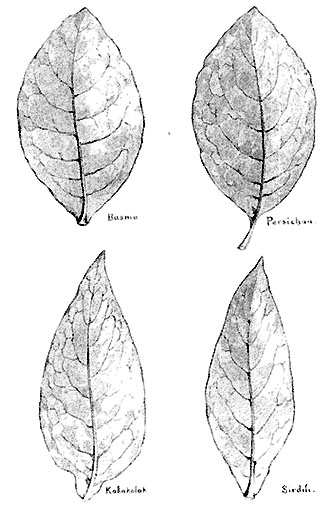
Xanthi is a Basma type. The pyramidal shape means that the lower leaves are consistently larger than those above. Most burley varieties are pyramidal, while some Cuban varieties are columnar. My Corojo 99 is columnar, and often reaches over 7' in height, with a spread of over 25" from the stalk.

TurkishTobacco_Leaves.jpg

Turkish tobacco leaf shapes: Basma; Persichan; Kabakolok; Sirdili.

Bob
 

NewTobaccoGrower

Well-Known Member
Joined
Jan 31, 2024
Messages
99
Points
33
Location
Florida & West Virginia
Question for anyone who might know-- does tobacco depend exclusively on animal pollination, to pollinate? In other words, if raising different varieties in an indoor room, would I need to bother "chifoning" the flowers? Will pollination still take place by way of air circulation? Of course there is no such thing as a 100% clean room, and I suppose if a single gnat crawled over one and then the other, it could pollinate it....
 

deluxestogie

Administrator
Staff member
Joined
May 25, 2011
Messages
26,108
Points
113
Location
near Blacksburg, VA
Nicotiana tabacum is about 90%+ self-pollinated. Unintentional crossing occurs mostly by insect, though hummingbirds may sometimes play a role. But mostly moths, flies, bees do the cross-pollination.

Since I have assorted flying insects sneaking into my house during the summer, I have bagged seed heads for the few times that I kept plants indoors. Only on those occasions did I ever see whiteflies and aphids inside my house.

Bob
 
Top