let's see your veggie garden {pics}

Status
Not open for further replies.

deluxestogie

Administrator
Staff member
Joined
May 25, 2011
Messages
26,223
Points
113
Location
near Blacksburg, VA
Garden20180710_3652_beanFence_600.jpg


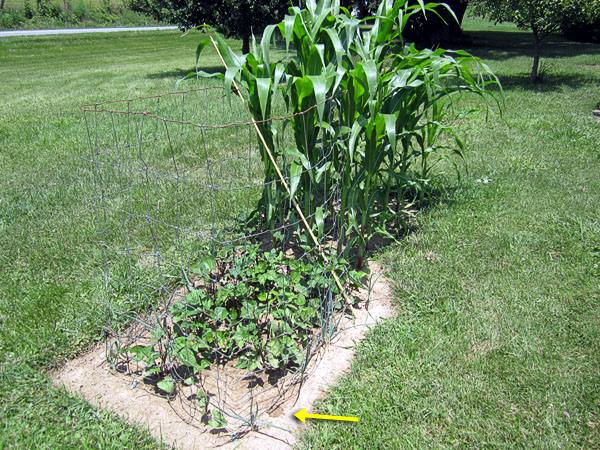
Yesterday morning, I noted a deer print (arrow) beside my recently grazed, purple string beans. I'm a generous guy, but the deer grazed my beans similarly last year--on a daily basis.

So, in the afternoon, I installed a 3-sided fence, guarded on the 4th side by my stand of Missouri Meerschaum cob corn. [Do deer like corn?] Seriously, they never bothered my cob corn last year. And if you can't trust a deer to be consistent, then who can you trust?

The stiff, box fence is staked at 4 corners. The bamboo diagonal runs from the back bottom to the other back top, for stability. Rabbits can still get in, but I can live with that for now.

Bob
 

deluxestogie

Administrator
Staff member
Joined
May 25, 2011
Messages
26,223
Points
113
Location
near Blacksburg, VA
Garden20180715_3659_BigBeefTomato_500.jpg


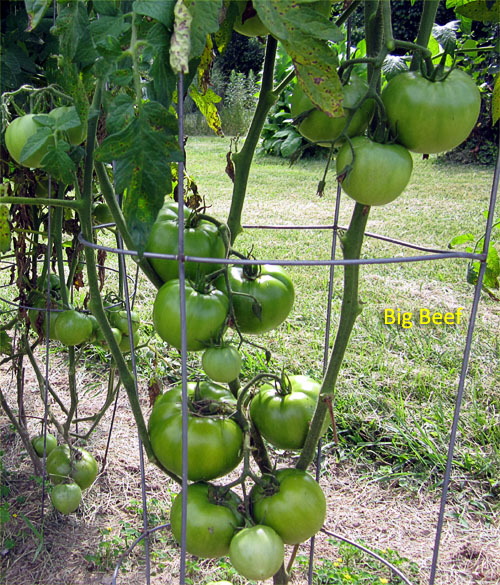
These will all be fairly large tomatoes, being a "beefsteak" type. Although, out of 7 Big Beef plants, I've had several ripen, most of the fruit appear to expect themselves to ripen all at once. That would leave me in a sauce!

Big Beef is the most pathogen-resistant tomato variety available. What that means is that it gives a much needed, lucky break to the pathogens that would have otherwise been outperformed by their pathogenic competitors. There's always something lurking out there. Note all the lower leaves, which shriveled and died, have been removed. Given the specific resistance of Big Beef, I simply know exactly what that blight is not. Whoopie!

I have 4 Roma tomatoes as well, and they have been equally prolific. In addition, I have 3 plants that are tardy: 1 German Green (from my neighbor), and two different volunteers (heaven knows what they are) that I moved from a different bed.

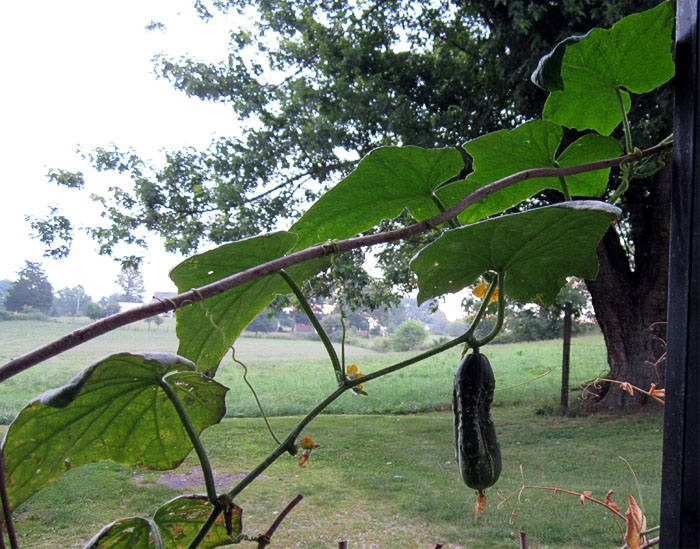
My crookneck squash has been pretty much a bust for this year, my sugar pod peas late and scant, and my string beans are finally recouperating from a grazing. I have a single cuke ripening.

Sometimes the magic works, and sometimes it doesn't. This will be the Year of the Tomato.

Bob
 

OldDinosaurWesH

Well-Known Member
Joined
Jul 31, 2017
Messages
959
Points
93
Location
Dayton Wa.
Bob:

Your tomatoes are looking good.

I am attaching one measly photo, of my one measly squash hill, that will probably actually produce a couple of squash. I planted my squash and melons too late, and they just don't have the time needed to be fruitful. Oh well...live and learn.

Tobacco Seedlings 7-15-18 -43 tern 7.jpg

I was surprised how big the leaves were. This is "Queensland Blue." Seed from nothwoodseed.

Wes H.
 
Last edited:

OldDinosaurWesH

Well-Known Member
Joined
Jul 31, 2017
Messages
959
Points
93
Location
Dayton Wa.
Good Eye! That's my sprinkler stand, for watering later season tobacco. Said stand is a little over 6 feet tall.

You can get some scale of the size of the squash leaves compared to the bucket. But, I don't really have any experience with squash. I just know they are good to eat. This variety is supposed to produce a 10 - 12# fruit.

Wes H.
 

deluxestogie

Administrator
Staff member
Joined
May 25, 2011
Messages
26,223
Points
113
Location
near Blacksburg, VA
It's a winter squash, so you have plenty of time. The instructions on the seed site are thorough. It should be nicer eating than field pumpkin.

Bob
 

OldDinosaurWesH

Well-Known Member
Joined
Jul 31, 2017
Messages
959
Points
93
Location
Dayton Wa.
The Seed site said this variety of squash was a 90 day maturity. That's one of the reasons I picked it out. Again, I don't know much about squash, but I was under the impression squashes are fairly easy to grow. I guess I'll find out. Hopefully they will be sweet... unlike those giant Hubbard squashes our mom used to feed us.

That is the beauty of modern Agriculture, always improving stuff. (Not always for the better.)

Wes H.
 

ChinaVoodoo

Moderator
Joined
Sep 1, 2014
Messages
7,220
Points
113
Location
Edmonton, AB, CA
Abstract Buttercup squash (Cucurbita maximaDuchesne 'Delica') fruit were heated to 30 or 33°Cin air for up to 7 days, then stored at 12°C for up to7 weeks. Control fruit remained at 12°C throughout.Sucrose and starch concentrations were measured inedible portions of raw squash, and the perceivedsweetness of the cooked fruit was evaluated using atrained sensory panel. Enzymes of starch degrada-tion and sucrose metabolism were also extracted andassayed. Sucrose content, on a dry weight basis, wasas much as 250% higher in heat-treated fruit than infruit kept at 12°C. Sucrose accumulated with increas-ing length of treatment and continued to accumulateduring subsequent storage. There was a strong cor-relation between sucrose content and panel sweet-ness rating. Heat treatments also increased the red/yellow colour of the flesh. Both increased sucroseconcentration and redder flesh colour appear to in-crease the acceptability of buttercup squash to con-sumers. In a subsequent experiment, we found thatextractable activities of α-amylase, β-amylase,starch phosphorylase, D-enzyme, sucrose synthase,sucrose phosphate synthase, maltase, and maltosephosphorylase did not differ in samples taken fromheat-treated or non-heat-treated squash.
https://www.google.ca/url?sa=t&sour...FjACegQIAhAB&usg=AOvVaw0IGxo5SOjG7f4_dfFpCehM

But how in the world would you heat treat your squash?
On that note, I've been planning on making black garlic in my kiln. It's almost the same process as kilning tobacco.
 

deluxestogie

Administrator
Staff member
Joined
May 25, 2011
Messages
26,223
Points
113
Location
near Blacksburg, VA
But how in the world would you heat treat your squash?
That's just a week, resting in the shade on my front porch in summer weather. It's similar to setting a nearly ripe tomato on the window sill for a few days.

That abstract doesn't mention it, but a week or two of heat treatment of squash (usually called "curing") hardens the rind, and further closes the channels in the stump of stem. So winter squash that has been cured prior to cool storage (the floor of my kitchen pantry) takes longer to spoil.

Bob
 

deluxestogie

Administrator
Staff member
Joined
May 25, 2011
Messages
26,223
Points
113
Location
near Blacksburg, VA
Here in Redneckistan, potatoes are planted inside an old tire. Then, as the plants grow, more old tires and more dirt are added, until the stack is as high as the broken refrigerator lying down in the yard.

Bob
 

ChinaVoodoo

Moderator
Joined
Sep 1, 2014
Messages
7,220
Points
113
Location
Edmonton, AB, CA
Here in Redneckistan, potatoes are planted inside an old tire. Then, as the plants grow, more old tires and more dirt are added, until the stack is as high as the broken refrigerator lying down in the yard.

Bob

My wife doesn't even use a microwave. I don't know how she'd feel about tire potatoes.
 

deluxestogie

Administrator
Staff member
Joined
May 25, 2011
Messages
26,223
Points
113
Location
near Blacksburg, VA
Think of it as recycling. Recycle the rubber, the road grime, the road salts, the old fuel lead. And it's a nicer place for your old tires than just tossing them on the roof to keep the wind from ripping off the rusty tin sheet. Think of it as nature's balance.

Bob
 

deluxestogie

Administrator
Staff member
Joined
May 25, 2011
Messages
26,223
Points
113
Location
near Blacksburg, VA
It is nice, but the yield is limited. One benefit is that the critters are less prone to come close to the veggies.

At the porch, I have sugar pod peas, tomatoes, cukes and leaf lettuce. In other years, I've gone with a single veggie per season: scarlet runner beans; cherry tomatoes; tiny pear tomatoes, genuine cornfield beans. Anything that climbs. This summer, there should have been about 20 pea plants, but I only have 4 or so, and those are now toast. Since it's only a half-day of sun, the two tomatoes (Big Beef and Roma) have been slow to ripen, though productive.

The Black Seeded Simpson lettuce and the two surviving cuke vines (started with 6) are growing in a 1020 tray sitting on the porch itself. [I was too blown out to prepare a spot for them in the garden when the time came.] The lettuce is a bit leggy, but out in the garden, the rabbits entirely consume any lettuce that is not securely fenced. Since Black Seeded Simpson is the one variety of lettuce that is least likely to bolt in the summer heat, I may get a salad or two out of them.

Bob
 

wooda2008

Well-Known Member
Joined
Mar 15, 2014
Messages
119
Points
28
Location
Vermont
My tobacco plants were a total bust, so I've been pouring my energy into the veggies.

3-sisters bed is doing the best.

IMG_20180711_132635788.jpg
 

deluxestogie

Administrator
Staff member
Joined
May 25, 2011
Messages
26,223
Points
113
Location
near Blacksburg, VA
If "Redneckistan" don't come from Turkey, it ought to man. [The pun in the previous sentence is so truly awful that even I can't allow it to remain on the page, without at least admitting an eye roll and a pathetic groan.] I would use the term, "Appalachia", instead of "Redneckistan", but fear that some might accuse me of racism--that is, condemn me as an elitist who does not consider NASCAR to be an actual sport. So Rednekistan it is.

Speaking of Appalachia, there is a vague history from the 1600s of a Spanish warship that took hundreds of Turks captive (they were at war then) [some stories say they were Portuguese captives], intending to sell them into slavery in the Caribbean, but due to devastating storms at sea, abandoned the captured Turks onto the coast of what is now North Carolina. These "Turks" were said to have migrated inland, taken Native American squaws, as well as free African wives, and eventually settled into the Appalachian mountain chain. This is one of the many conflicting legends of the origin of Melungeons--a bronze skin, Turkish appearing population (long head, long, narrow nose, blue eyes) still present today in central Appalachia, in the region of the Cumberland Gap (southwest Virginia, eastern Kentucky and eastern Tennessee).

On the distant subject of vegetables -- does anyone know what sort of tiny, green caterpillar invades cucumbers? My next door neighbor gave me a handful of large cucumbers yesterday, and while they rested in a colander in my sink, after rinsing, a 0.75" long, apple green caterpillar crawled out of a tiny hole in one of the cukes, and said, "Howdy!"

Bob

 
Status
Not open for further replies.
Top