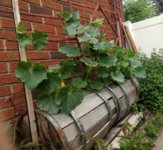
let's see your veggie garden {pics}

Status
Not open for further replies.

BarG

Founding Member
Joined
Jun 23, 2011
Messages
5,107
Points
113
Location
Texas, Brazos Vally
I need to learn more about growing asparagus and garlic, 2 of my favorites. What kind of location do you choose and when to plant?

 

squeezyjohn

Well-Known Member
Joined
Jul 31, 2012
Messages
1,008
Points
63
Location
Oxford - UK
For asparagus ... the more work you put in the more you get out of it ... it's a long term perennial crop. Buy the best quality crowns you can lay your hands on ... I prefer 2 year old crowns. Create a bed for them and make sure to dig every single perennial weed root out because once it's planted you can't dig that area again. Load it up with manure and make sure it has enough drainage ... if your soil is heavy add loads of sand too and hill the bed up above the surrounding area, make sure you can access every part of the bed without standing on it to harvest. Dig large holes for the crowns 2ft apart at the centre, then make a little conical hill in the centre of the holes and plant the crown on top of those hills with the roots trailing down in to the hole and cover. In the first year or two - don't harvest anything, just let them turn in to ferns ... after that the crops should keep coming for up to 20 years. All you have to do is weed the bed, stop harvesting 2 months after you get the first spear of the year, let the ferns grow until they die back, cut the ferns down in winter and cover the bed with a layer of manure or compost to feed. In all but the worst of droughts it should cope with getting it's own water from underground, but if you water well during the season - it will give you more and fatter spears.

Garlic is the easiest thing in the world. Push cloves about 2" down in to the ground in November/December spaced about 10" apart ... they'll start coming up in January once they've rooted. Keep weeded (it's easier to hoe if you plant them in a neat grid). Maybe add a little feed of something nitrogen heavy in the spring to help them grow. They'll be ready to harvest in July (hardneck varieties will throw a curved flower stalk called a scape which it's best if you cut off so you get bigger bulbs ... they can be eaten and are delicious stir-fried) ... hardnecks are ready about 2 weeks after the scapes have come. If you have particularly tough winters - it's possible to plant in early spring too, but the garlic needs a spell of cold weather to trigger it splitting in to cloves ... sometimes spring sown garlic produces huge mono-cloves which are harder to cook with - but just as tasty.
 

ChinaVoodoo

Moderator
Joined
Sep 1, 2014
Messages
7,220
Points
113
Location
Edmonton, AB, CA
My garlic did not survive the winter. I'm guessing raised beds don't offer the same protection and stability as flat ground would. If I was to have mulched, I would have needed to have munched the entire bed, even around the perimeter. Oh well. More room for other stuff!
 

deluxestogie

Administrator
Staff member
Joined
May 25, 2011
Messages
26,224
Points
113
Location
near Blacksburg, VA
I often apply 8 to 12 inches of pine needle mulch. It survives winter temps of -5° F. Raised beds present a problem similar to a perennial potted plant.

Bob
 

skychaser

Well-Known Member
Joined
Aug 30, 2012
Messages
1,117
Points
113
Location
NE Washington
About 100 years ago there was an asparagus farm on the prairie where I live. It has grown wild around here ever since. We used to go out and pick buckets of the stuff when I was a kid. There isn't as much around now as there was back then, but it's still easy to find. Personally, I hate it. Nasty bitter stuff. lol But my wife and sister love it so I still pick some for them.
 

OldDinosaurWesH

Well-Known Member
Joined
Jul 31, 2017
Messages
959
Points
93
Location
Dayton Wa.
Will the deer eat my watermelons or squashes?

I'm planting short season Watermelons, as well as a shorter season squash this year, in addition to my usual tobacco crop. I'm wondering if this is a waste of time as I have a substantial number of deer that I can't effectively keep out. The deer don't bother the tobacco, but I have had them eat the blooms off of my roses, as well as the blooms off of my tomatoes. Pesky critters!

Any suggestions or ideas?

Wes H.
 

deluxestogie

Administrator
Staff member
Joined
May 25, 2011
Messages
26,224
Points
113
Location
near Blacksburg, VA
Plant them, and find out. I have deer stroll through and munch on stuff. I've never had them mess with the squash, the cukes, the watermelons or cantaloupe. The rabbits don't seem to bother those either. Both deer and rabbits (and the groundhog) will much my peas, beans, peppers, tomatoes, and small corn shoots. Once the corn is taller, the deer are sometimes a problem.

An effective deer deterrent for short veggies is the use a section of box wire fence to create an arch above the bed. Also, bird netting (a true pain in the butt) will keep them away from some things.

Bob
 

OldDinosaurWesH

Well-Known Member
Joined
Jul 31, 2017
Messages
959
Points
93
Location
Dayton Wa.
My preferred large pest control method would be buckshot, but I can't get away with that.

I'm seeing a pattern in the plants you mention as unaffected or mostly unaffected by deer. They all seem to be members of the gourd family. Perhaps the deer find those gourds unappetizing.

But, (Bob) we seem to be on the same wavelength. I was going to go ahead & plant them & see what happens. Worst case is that my patch goes fallow for a year. All the better to grow tobacco next year.

Wes H.
 

deluxestogie

Administrator
Staff member
Joined
May 25, 2011
Messages
26,224
Points
113
Location
near Blacksburg, VA
When it comes to plopping in some seed, I have little emotional tie to the ultimate outcome. When I've raised them from wee little things, and nurtured them for a couple of months, prior to putting them out, then I feel somewhat more dyspeptic toward critters that can't even wait for them to grow a bit larger--large enough to share. This is especially true for unusual varieties that simply are not for sale at any market.

Bob
 

skychaser

Well-Known Member
Joined
Aug 30, 2012
Messages
1,117
Points
113
Location
NE Washington
I've never had them mess with the squash, the cukes, the watermelons or cantaloupe. The rabbits don't seem to bother those either. Both deer and rabbits (and the groundhog) will much my peas, beans, peppers, tomatoes, and small corn shoots. Once the corn is taller, the deer are sometimes a problem.

An effective deer deterrent for short veggies is the use a section of box wire fence to create an arch above the bed. Also, bird netting (a true pain in the butt) will keep them away from some things.

Bob

The deer here eat pretty much everything if given a chance but tobacco. Nothing around here eats the tobaccos. Deer will nibble on corn when it first comes up but after it gets 3-4 inches high they lose interest. I have had deer eat both the squash plants and gnaw on the mature squash. Some years they hardly bother them and others they destroy them. They eat the cantaloupe types of melon plants to the ground if not fenced.

Everything we grow has to be fenced but tobacco and corn. No rabbit problems here, but we have marmots. Lots of marmots. Way too many damn marmots! They don't seem to like corn much either but they absolutely devastate almost any thing else. All our fencing 6' high and is either chain link or chicken wire at the bottom buried 6 inches deep.

Our local farm store sells a very light weight 1/2" mesh netting in 6' x 100' rolls for $20. It is very effective in stopping plants from being eaten when laid over them. It also makes a quick easy fence and lasts for years.
 

deluxestogie

Administrator
Staff member
Joined
May 25, 2011
Messages
26,224
Points
113
Location
near Blacksburg, VA
On the Front Lines

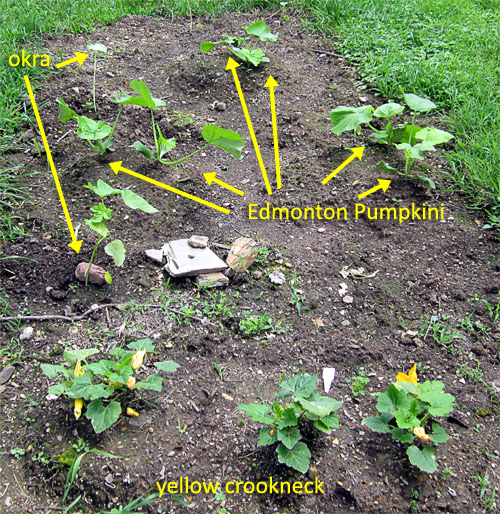
Garden20180602_3592_backBed_500.jpg


This 5' x 12' garden bed is the only one behind the house. It is adjacent to a pasture of tall hay, ready for harvest. Nearby are two substantial brush piles. So every creature that reluctantly wanders out into the open yard encounters this spot first. It's like the little table of free sample snacks in the super market. "Try one. See how you like it."

After two months of indoor nurturing, 6 okra plants were put into this bed about a week ago. Only two survive, and only one of those is really thriving. The critter masses don't seem to care that much for the squash. The yellow crookneck was purchased as transplants. The Edmonton Pumpkini is from seed.

Bob
 

ChinaVoodoo

Moderator
Joined
Sep 1, 2014
Messages
7,220
Points
113
Location
Edmonton, AB, CA
I am taking a sabbatical from growing the Edmonton pumpkini this year. We will be trialling the kabocha squash, and sum kind 'um striped zucchini. I look forward to seeing how big the pumpkini gets in a warmer climate. I do suspect that you will need to leave a trail of bread crumbs to enter and safely exit that patch in a month or two.
 

CobGuy

Well-Known Member
Joined
Dec 22, 2015
Messages
1,041
Points
113
Location
Central Arizona
Our Okra produced some very "woody" fruit / pods last year and I've heard it takes a season or two before this changes ... any info you guys have heard?
 

deluxestogie

Administrator
Staff member
Joined
May 25, 2011
Messages
26,224
Points
113
Location
near Blacksburg, VA
Our Okra produced some very "woody" fruit / pods last year and I've heard it takes a season or two before this changes ... any info you guys have heard?
In temperate climates, okra is usually cultivated as an annual, though it is perennial in tropical areas. So, no. I've never heard of what you're describing. I would suggest that you harvest them when very tiny, then through that same season, allow each subsequent picking to grow a little larger, until you determine the optimal size without woodiness.

There are many varieties of okra. I always grow Clemson Spineless, and typically pick them at about 3-4" in length. Most varieties get woody if you allow the pods to grow too large.

I do suspect that you will need to leave a trail of bread crumbs to enter and safely exit that patch in a month or two.
Uh oh! Are you saying that the vines are not all that civilized? I was planning to harvest some of the pumpkini when small and tender, and see if they also work as a summer squash. I've thinned them to a mere 6 plants. Should I kill half of them while I still can?

Bob
 

CobGuy

Well-Known Member
Joined
Dec 22, 2015
Messages
1,041
Points
113
Location
Central Arizona
In temperate climates, okra is usually cultivated as an annual, though it is perennial in tropical areas. So, no. I've never heard of what you're describing. I would suggest that you harvest them when very tiny, then through that same season, allow each subsequent picking to grow a little larger, until you determine the optimal size without woodiness.

There are many varieties of okra. I always grow Clemson Spineless, and typically pick them at about 3-4" in length. Most varieties get woody if you allow the pods to grow too large.

Bob

Ahhhh ... this could be what I was thinking. Thanks! :)
 

ChinaVoodoo

Moderator
Joined
Sep 1, 2014
Messages
7,220
Points
113
Location
Edmonton, AB, CA
In temperate climates, okra is usually cultivated as an annual, though it is perennial in tropical areas. So, no. I've never heard of what you're describing. I would suggest that you harvest them when very tiny, then through that same season, allow each subsequent picking to grow a little larger, until you determine the optimal size without woodiness.

There are many varieties of okra. I always grow Clemson Spineless, and typically pick them at about 3-4" in length. Most varieties get woody if you allow the pods to grow too large.


Uh oh! Are you saying that the vines are not all that civilized? I was planning to harvest some of the pumpkini when small and tender, and see if they also work as a summer squash. I've thinned them to a mere 6 plants. Should I kill half of them while I still can?

Bob
It doesn't really grow like a pumpkin. It doesn't spread, really. It just gets big where it sits, like a zucchini. There seems to be an imbalance of male to female flowers, so I only got two or three per plant. If they become unruly, you can always put them in their place.
 

deluxestogie

Administrator
Staff member
Joined
May 25, 2011
Messages
26,224
Points
113
Location
near Blacksburg, VA
Well...(He stares at his feet.)...today I planted my purple string beans. That little bag of beans just sat there on the kitchen counter for 2 months, reminding me how far behind I am this summer. If the deer don't graze them first, I'll have some beans in August. The problem has been that I didn't finish removing last summer's giant-stalk corn roots from their bed. So I finally just went out there and dug up those corn roots from hell. The bean part was easy.

I'll be digging garlic in 2 or 3 weeks. I still have some tobacco to go in. And my piece of crap, twenty year old John Deere lawn tractor is still giving me fits. I spent 3 hours today getting 40 minutes of mowing done.

Bob
 

deluxestogie

Administrator
Staff member
Joined
May 25, 2011
Messages
26,224
Points
113
Location
near Blacksburg, VA
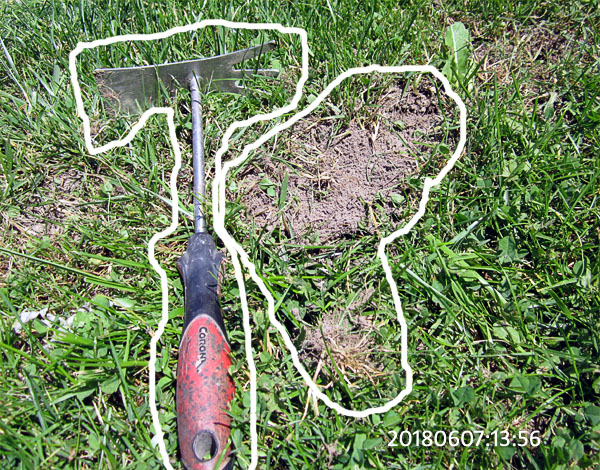
Scene of the Crime

Garden20180607_3599_sceneOfTheCrime_600.jpg


The Confusion:
I'm an old guy. So it's not unusual for my eyes to play tricks on me. While sitting on my porch, puffing on a fat stogie, I noticed motion in the grass just beyond the porch. I blinked. (This is a time-honored reset button for one's eyes.)

The Realization:
Yes indeed! A small spot of grass was gently oscillating against a background of stable turf. I stared at it for a few beats. A mole! There's that little SOB that's been tunneling beneath my porch corner garden bed.

The Weapon:
I looked about. In the adjacent porch chair rested my trusty, stainless steel garden hand spade. Over the years, that $10 tool has cumulatively dug and tilled the earth for well more a thousand tobacco plants. I lifted it, and gently stood up, hoping to generate no vibrations in the ground.

The Attack:
I descended the four porch steps as softly as I could manage, and approached the still oscillating nob of grass. With a powerful swing, I drove the forked end into that very spot. I struck again. Then I plunged the blade into the apparent paths leading up to the incipient molehill.

The Aftermath:
Nothing stirred. I examined the fatal edges of the tool. No blood. I know that moles can easily dig 100 feet of new tunnel in a day, but they don't seem built for speed. So I either whacked it, or it fled like a demon.

I'm not a squeamish person. Blood is, after all, just a working fluid. But I recognize that visualizing a dead little creature (like a mouse with its head squished flat by a mousetrap) is not particularly gratifying to me. So I didn't verify the kill by digging out the body.

Moles create cosmetic blemishes in manicured lawns. Beyond that, they create ankle-breaking pitfalls for codgers walking across the ground. But in general, moles help keep the ground healthy. Live and let live. But if you screw with me...

Bob

EPILOGUE: I flooded the tunnels with gallons of water, to degrade any DNA evidence.
 

ChinaVoodoo

Moderator
Joined
Sep 1, 2014
Messages
7,220
Points
113
Location
Edmonton, AB, CA
This time of year, I like to reassure myself, "The garden just went in. It's ok, you've got 4 months for those tomatoes to flourish, 4 months for those tobacco plants to rise up and mature." But this year, I look at my kabocha squash, which I've never grown before, and I say to myself, "My god! This thing is going to grow for another 4 months!"

IMG_20180609_173746165~2.jpg

I honestly think I could build a gateway type trellis and have it arch over the sidewalk.
 
Status
Not open for further replies.
Top