
Any commercial tobacco grower makes a handsome profit selling transplants at $1.99, but that is quite low a price for purchasing some nice transplants. Stroke of luck for you.
Bob
Bob



So is flue curing this variety out of the question? I haven’t been to impressed with sun curing virginias personally. It is ok at best and a bit of an inconvenience (moving them in and out when rain is threatening) for the end result. I know Virginias are traditionally flue cured but didn’t know if dark Virginias follow more of the tradition of the dark variety.Shirey is normally air-cured. The lower leaves aren't as markedly different from bright-leaf Virginia IMO and could maybe be sun cured. I wouldn't put all my eggs in that basket but wish I had a go at it last year when I had the opportunity.
Mid-leaf and above is somewhat darker so I'd definitely stick with tradition and air cure it. Mine took a fair bit of kilning and resting time too, but it didn't cure out very well in the first place (due to my own growing/curing conditions; not the strain). I'd suggest pressing some of it too. I made some "carottes" from mine with good results; saves a lot of space too.
I've never flue cured myself, but I guess it could be worth experimenting with a few of the lower leaves since they're brighter and sweeter; not too far off bright-leaf VA. I'd be much less inclined to rush the curing process for the leaf further up. I've only grown the stuff once but I found it takes its time to yellow up nicely and just doesn't feel like it wants to be rushed. My plants did have a bit of a troubled upbringing though, so may not be the best point of reference.So is flue curing this variety out of the question? I haven’t been to impressed with sun curing virginias personally. It is ok at best and a bit of an inconvenience (moving them in and out when rain is threatening) for the end result. I know Virginias are traditionally flue cured but didn’t know if dark Virginias follow more of the tradition of the dark variety.
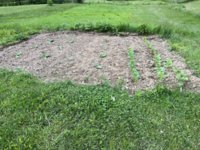
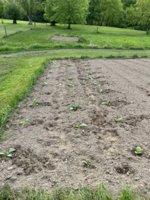

Nice plants!! Good luck this seasonSo I am finally done planting except for buckeye red which had some trouble in the beginning and I am now waiting on some new seedlings to reach planting maturity (likely another week). View attachment 41897
Those are my orientals on the far right (prilep and krumovgrad). The rows are a bit serpentine and the spacing leaves a bit to be desired. I hurriedly planted them before a storm in the morning before work. I also used generous 3 foot spacing on all other plants with hopes it would increase yield size. There are some leaves that can be seen laying around the yard and garden plots. I pulled some bottom leaves off of plants in order to plant their stems further down. I have never really done that to this degree before and I hope I didn’t get carried away. View attachment 41898


I was thinking cutworm but the whole plant is missing. Thought maybe it blew away but no sign of it anywhere….oh well I guess…The one completely missing could be the victim of a cut worm, or it was a handy bit of nesting material for a bird. (Grackles here seem to do that.) The munched leaves look to me like cricket damage. For mine with obvious cricket damage, I just sigh, and wait for the plant to grow larger.
To look for a cutworm beneath the missing plant, first search for a singular ¼" hole in the ground nearby. If there is one, bring up a large clump of soil at the scene of the crime, using a shovel. Then break it apart, and look for a curled insect larva (about the size of the last phalanx of your pinkie finger). They come in various colors.
Bob
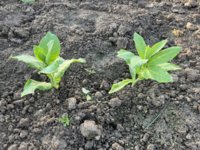
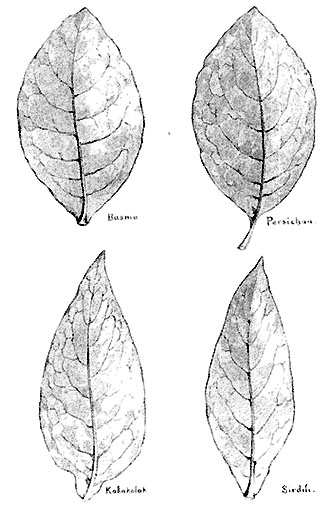
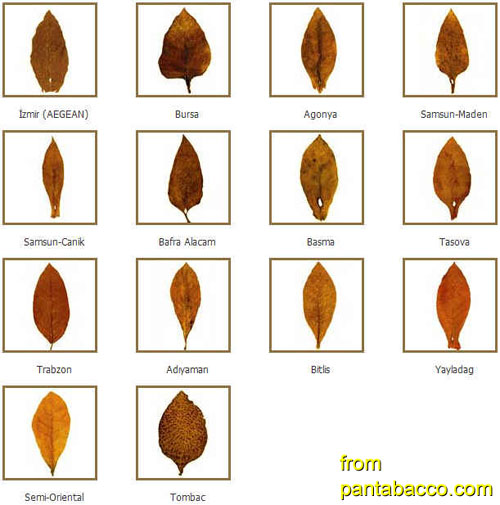
Hmm, very interesting. So why would you discourage saving seed from this particular plant? I understand why in the case that it is in fact a prilep seed that exhibits non traditional physical characteristics but if it is in fact a different variety altogether, what harm is there in saving seed (other than not knowing for sure what variety it is)? Thank you for the leaf pictures…very interesting.That is clearly a "sirdili" [ox tongue] leaf shape. My guess is that it comes from a stray seed, rather than a mysterious mutation. Yup. Not Prilep.
Oriental leaf categories [from Constantinides]
Turkish Varietals [from Pantabacco]
I would definitely treat it like an Oriental, and sun-cure it. I would discourage you from saving seed from it. Be sure to label it separately from the rest of your leaf. [Red-headed step-child] I've grown and sampled several dozen distinct Oriental tobacco varieties. Each has its strengths and weaknesses. Let us know what you end up with.
While I can't blame it on the milk man or the pool boy, it is easy to imagine a stray seed electrostatically jumping from one piece of equipment (or fingernail) into seed of another variety. [The probability of that never happening is vanishingly small.] Although genetic homozygosity (no recessive variants) is the assumption for established tobacco varieties, reality sometimes falls short of the ideal.
Bob
Right, I agree with you on that point and am aware that it is currently an unidentified tobacco variety. Its growth rate and physical attributes thus far strongly suggest it belongs in the oriental family but again, I just don’t know for sure. The scenario I fear is that I grow it out, top it, cure and age the leaf. A test smoke some time down the road reveals to me this leaf is a personal favorite of mine and I now have no way of even attempting to reproduce the mysterious tobacco variety of my dreams. Although this is hypothetical, improbable, and delusional it is, in my opinion, easily avoidable…haha. I know seed saved from this plant may not even grow true but I am nonetheless attracted to the mystery of the stow away tobacco variety of 2022.You may choose to save seed from the mystery plant, so long as you consider it a mystery plant, perhaps not even an Oriental. You just don't know.
I didn't intend to sound quite so snooty about it. I should have said that I would discourage you from sharing its seed. We do have a number of varieties floating among forum members (e.g. "White Angel Leaf" burley, "NB-11" probable burley, "Pieate Cuban" etc.) that exist solely because of careless tracking of their correct identities. Are they unique? Almost certainly not. They are just misidentified.
Bob

Looking forward to the name you come up with. Buckeye Baccy? Midwest Mystery?Right, I agree with you on that point and am aware that it is currently an unidentified tobacco variety. Its growth rate and physical attributes thus far strongly suggest it belongs in the oriental family but again, I just don’t know for sure. The scenario I fear is that I grow it out, top it, cure and age the leaf. A test smoke some time down the road reveals to me this leaf is a personal favorite of mine and I now have no way of even attempting to reproduce the mysterious tobacco variety of my dreams. Although this is hypothetical, improbable, and delusional it is, in my opinion, easily avoidable…haha. I know seed saved from this plant may not even grow true but I am nonetheless attracted to the mystery of the stow away tobacco variety of 2022.
I don’t know that I have naming rights to it. It most likely already has a name but I will see what I get with it. I’ve been working on a hybrid that I will name in a few more years if I am happy with the leaf it produces and see that the seed it produces grows true (it surprisingly already seems to be.) I have grown the initial hybrid seed (created using the techniques Described in the intentional crossing section of key forum threads) out to seed twice now, making it an F2 bright leaf x burley. I had made two other hybrids as well but I chose to abandon them and keep this one. Anyway, I was looking through different oriental varieties sold by @skychaser to try and narrow down what it could possibly be (assuming it is in fact a rogue oriental seed) but I soon recognized that to be a fruitless endeavor as he has an astounding number of orientals for sale. Time will tell I guess…Looking forward to the name you come up with. Buckeye Baccy? Midwest Mystery?

We discuss any variety of tobacco, as well as numerous approaches to growing, harvesting, curing, and finishing your crop. Our members will attempt to provide experience-based answers to your questions.